
The history of play is as old as humanity itself, with the first toys dating back tens of thousands of years. From simple sticks and stones to intricate mechanical puzzles, understanding when was the first toy invented reveals how play has always been essential to human development and cultural expression.
Have you ever watched a toddler find endless joy in a cardboard box while ignoring the expensive gadgets next to them? It is a scene that has played out for thousands of years. As we sit here in 2026, surrounded by AI-powered robots and virtual reality headsets, it is easy to forget that the concept of play is ancient. When we ask the question, “when was the first toy invented,” we are really asking when humans first realized that play was a vital part of life.
The truth is that play is a fundamental human trait. We didn’t wait for factories to start having fun. As soon as we could shape the world around us, we began making toys. Whether it was a carved bone or a smooth river pebble, our ancestors knew that a simple object could transform into a companion, a tool, or an adventure.
Key Takeaways
- Ancient Origins: The first toys date back to prehistoric times, likely involving natural objects like smooth stones or sticks.
- Play is Universal: Every human civilization across history has created objects specifically for entertainment and skill-building.
- Materials Matter: Toys have evolved from clay, wood, and stone to plastic and eventually high-tech smart devices seen in 2026.
- Educational Value: Throughout history, toys were not just for fun; they helped children practice adult roles and survival skills.
- Cultural Significance: Ancient toys often reflected the religious and social values of the time, acting as miniature versions of real-world tools.
The Prehistoric Roots of Play
Nature’s First Toys
Before recorded history, long before the invention of the wheel or the written word, our ancestors were playing. While we cannot pinpoint an exact date on a calendar for the first toy, archaeologists believe that children in the Paleolithic era were playing with what nature provided. Think of it as the original “open-ended” play. A sturdy stick could become a sword, a horse, or a walking cane. A round stone might be a ball or a pretend egg.
There is no specific record of when was the first toy invented because the very first ones were perishable. However, we have found prehistoric artifacts that suggest play was intentional. Children have always imitated their parents. If the adults were hunting, the children were throwing small spears at targets. If the adults were gathering, the children were playing with small baskets.
The Invention of the Doll
Dolls are arguably the oldest type of manufactured toy. In various parts of the world, early humans created figurines that represented people or animals.
These weren’t just mass-produced items; they were handmade with care. In ancient Egyptian tombs, archaeologists have found wooden dolls with articulated limbs.
These date back to around 2000 BCE. They were painted with intricate patterns, showing that play was a cherished part of a child’s life even in early civilizations.
Toys of the Ancient Civilizations
Playtime in Mesopotamia and Egypt
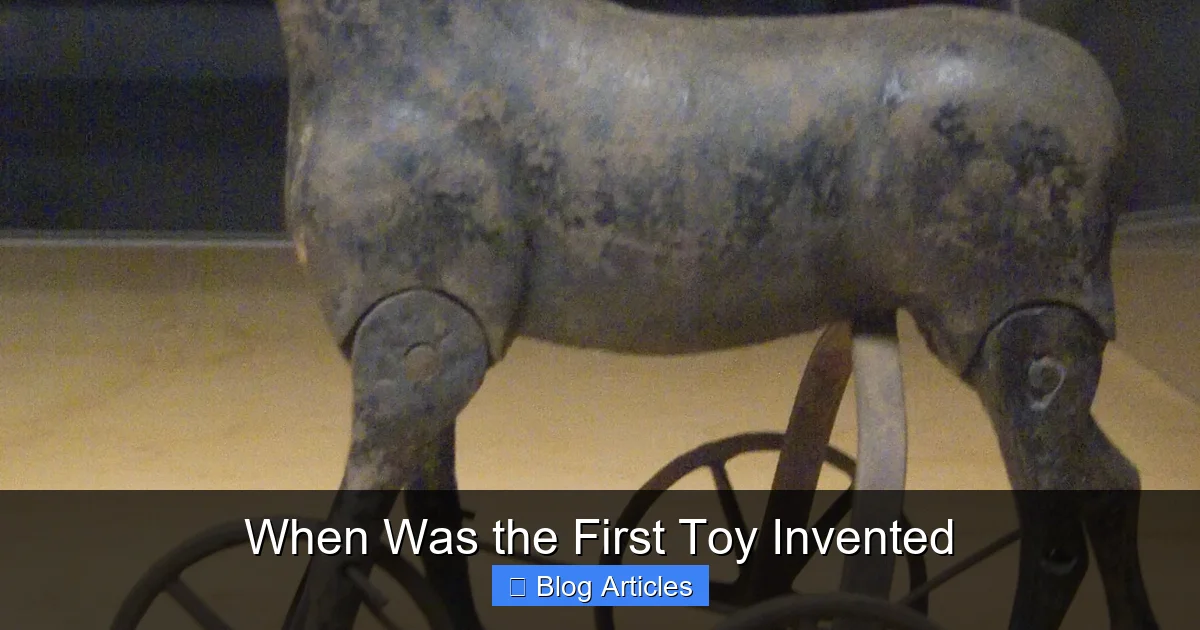
As civilizations grew, so did the complexity of toys. In Mesopotamia, archaeologists have unearthed small terracotta animals on wheels. This is a massive leap forward. When you ask when was the first toy invented that utilized physics, these wheeled animals from around 3000 BCE are strong contenders. It shows that ancient engineers understood the concept of motion and mechanics.
Visual guide about When Was the First Toy Invented
Image source: cdn.britannica.com
In Egypt, the range of toys was quite broad. Aside from the aforementioned dolls, children played with spinning tops, toy boats, and board games. One famous game, Senet, was played by both adults and children. It highlights a common theme: humans have always blurred the lines between games for children and games for the whole family.
Greek and Roman Innovations
The Greeks and Romans took play seriously. Philosophers like Plato and Aristotle wrote about the importance of play in a child’s education. They believed that playing with toys could help prepare children for the tasks they would perform as adults. By the time of the Roman Empire, toys were becoming more diverse. We have records of rattles, yo-yos, and even board games played on stone surfaces.
If you walked through a Roman market, you might have seen merchants selling terracotta figures of soldiers or animals. These were essentially the action figures of their time. They were affordable, portable, and sparked the imagination of children across the empire.
The Evolution of Materials and Manufacturing
From Wood to Metal
For most of human history, toys were made from whatever materials were local. In forest regions, wooden toys dominated. In river valleys, clay was the primary medium. It wasn’t until the Industrial Revolution in the 18th and 19th centuries that toys underwent a radical transformation. Suddenly, metal casting, tin lithography, and mass production made toys accessible to the middle class, not just the wealthy elite.
Tin toys became a massive trend. They were light, durable, and could be printed with vibrant colors. You could buy a tin soldier, a clockwork train, or a wind-up bird. When parents asked when was the first toy invented, they were usually looking at the shelf and seeing mass-produced items that were worlds apart from the crude sticks of the past.
The Rise of Plastics
The middle of the 20th century changed everything with the introduction of plastic. Plastic was cheap, moldable, and safe. It allowed for the creation of toys that were incredibly detailed. This era saw the birth of iconic brands that still dominate the market in 2026. Plastic allowed designers to create complex puzzles, building blocks, and dolls that could be mass-produced in the millions.
The Digital Shift of the 21st Century
The Interactive Revolution
Fast forward to the early 2000s and the arrival of digital toys. Play was no longer just physical; it became interactive. Electronic pets, handheld consoles, and eventually tablets transformed the way children engaged with their toys. The focus shifted from pure manual play to cognitive engagement and digital storytelling.
Toys in 2026
In our current year of 2026, the question of when was the first toy invented feels like a bridge between the primitive and the futuristic. Today’s toys often feature AI integration, where a doll or an action figure can learn, respond, and adapt to the child’s personality.
We have transitioned from sticks and stones to smart companions that can assist in education, coding, and language learning. Yet, even with all this tech, the core remains the same: a child holding an object and dreaming up a world.
Why We Need Toys
Learning Through Doing
Toys have always been the “practice ground” for life. When a child plays with a doll, they are practicing empathy and caregiving. When they play with blocks, they are learning basic engineering and spatial awareness. When they play a competitive board game, they are learning social rules and how to handle success and failure.
The history of toys is really the history of human progress. Every generation creates toys that reflect their current technology. If you look at a collection of toys from the year 1000, 1900, and 2026, you will see a perfect timeline of human curiosity and ingenuity.
Practical Tips for Choosing Toys
If you are looking for toys for a child in your life, keep these tips in mind:
- Less is often more: Open-ended toys like building blocks allow for more creativity than pre-programmed gadgets.
- Follow the interest: A toy is only as good as the interest it sparks. Observe what your child likes to do naturally.
- Think of durability: Good toys, much like the stone toys of our ancestors, should be able to stand the test of time.
- Balance tech and touch: While digital toys are great for logic, physical toys are essential for motor skills and tactile stimulation.
Conclusion
So, when was the first toy invented? While there isn’t a single “Eureka!” moment in a textbook, the first toy was invented the moment the first human child picked up a stick and decided it was something more. It was a moment of imagination that has echoed through the millennia.
From the stone balls of the Paleolithic era to the AI-enhanced gadgets of 2026, toys have served as our most important teachers. They reflect our past, define our present, and prepare our children for the future.
So, the next time you see a child playing with a simple toy, remember that you are witnessing one of the oldest and most important human traditions. Play is not just a pastime; it is the spark of our humanity.
Frequently Asked Questions
Is there a specific inventor of the first toy?
No, there is no single inventor of the first toy because play is a natural human behavior. Toys evolved gradually as early humans began to shape natural objects for entertainment and skill practice.
What is considered the oldest toy in the world?
While disputed, many historians point to small, carved animal figurines and smooth stones used as gaming pieces as the oldest toys. These date back tens of thousands of years to the prehistoric era.
How did ancient toys differ from modern ones?
Ancient toys were handmade from natural materials like wood, clay, and bone, and they often mimicked real-life adult tools. Modern toys in 2026 are mass-produced using plastics and digital technology to create interactive, learning-based experiences.
Why are toys important for child development?
Toys serve as vital tools for learning social skills, motor coordination, and emotional regulation. By mimicking adult activities through play, children prepare themselves for the challenges of the real world.
Were toys always for children?
Not necessarily; throughout history, many games and “toys” like board games or mechanical puzzles were enjoyed by both children and adults. In many ancient cultures, play was a shared community experience.
How have materials changed the toy industry?
The move from natural materials to metal during the Industrial Revolution and later to plastic allowed for mass production and durability. This made toys affordable for the general public, forever changing the way children play.