
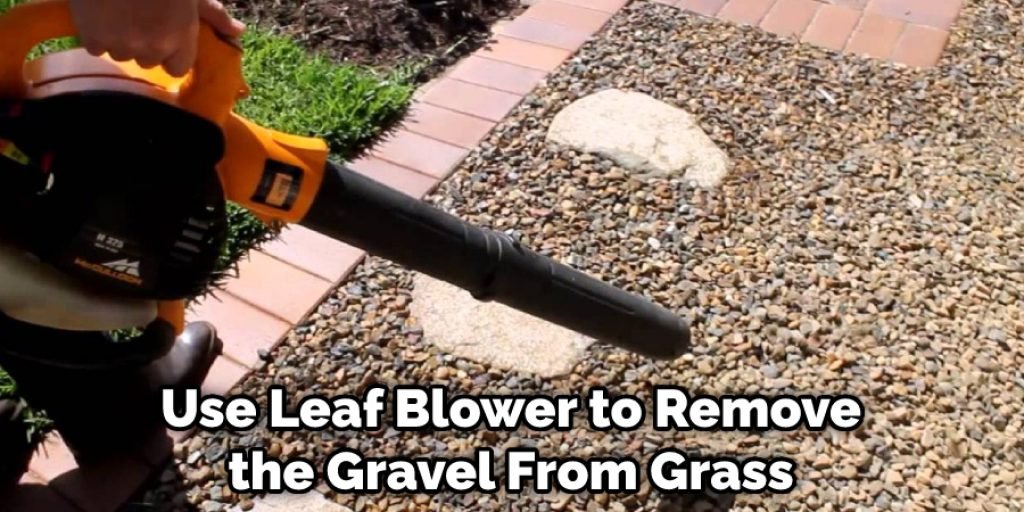
Removing leaves from gravel is easiest when you use low to medium air power, a shallow blowing angle, and short passes. Start at the edge of the gravel, blow leaves onto a lawn or tarp, and keep the nozzle high enough that it moves leaves without scattering stones.
This method works for most U.S. driveways, walkways, patios, and landscape beds. The best technique depends on the size of the gravel, how wet the leaves are, and the power of your blower.

What You Need Before You Start
You need a leaf blower, eye protection, hearing protection, sturdy shoes, and a place to collect the leaves. A rake, tarp, leaf bag, or compost bin can make cleanup much faster.
Before blowing, remove objects that could become airborne. Check for sticks, loose wire, toys, stones, and other debris. Leaf blowers can move small gravel, especially when used at full power.
Basic equipment checklist
- Battery, electric, or gas leaf blower
- Blower tube and nozzle
- Safety glasses or sealed eye protection
- Hearing protection
- Work gloves
- Long pants and closed-toe shoes
- Tarp, rake, lawn bags, or compost bin
- Dust mask if the gravel is very dry or dusty
The CDC and NIOSH explain that repeated loud-noise exposure can harm hearing. Use hearing protection when operating a loud blower, especially for long jobs.
Read the operating manual for your exact blower. Controls, battery limits, fuel rules, and safe starting procedures vary by model. Never point the blower at people, pets, windows, vehicles, or open doors.

Choose the Right Blower Setting for Gravel
Use the lowest setting that moves the leaves. High power is often unnecessary and can scatter gravel, damage delicate plants, or create a cloud of dust.
A blower moves air in a cone. The closer the nozzle is to the ground, the stronger that air stream becomes at the surface. Raising the nozzle by a few inches spreads the force over a larger area and helps leave the gravel in place.
A simple setting guide
| Surface or leaf condition | Starting approach |
|---|---|
| Large, dry leaves on large gravel | Low to medium power |
| Small leaves between stones | Medium power with a narrow nozzle |
| Wet or matted leaves | Medium power, then hand removal if needed |
| Fine pea gravel | Low power and a high nozzle angle |
| Heavy gravel or packed stone | Medium power with short passes |
| Dry, dusty gravel | Low power and slower movement |
These settings are starting points, not fixed rules. Blower strength differs widely between models. A compact battery blower may need a closer pass, while a powerful gas blower may move stones even at a moderate setting.
Test the blower in a small, hidden area first. If stones roll, bounce, or spray forward, reduce the power, raise the nozzle, or move farther away.
Why nozzle angle matters
Do not aim straight down at the gravel. Point the nozzle slightly forward and across the surface. This creates a moving air wall that pushes leaves ahead of it instead of forcing air directly into the stones.
A good starting position is:
- Hold the nozzle about 6 to 12 inches above the gravel.
- Aim at a shallow angle of about 15 to 30 degrees.
- Keep the nozzle moving.
- Work with the wind when possible.
- Lower the nozzle only when leaves are trapped.

Step-by-Step: How to Remove Leaves From Gravel With a Leaf Blower
The most effective method is to move leaves in small groups toward one collection area. Trying to clear the whole surface at once usually spreads leaves and increases the chance of moving gravel.
1. Pick a collection zone
Choose where the leaves will go before you turn on the blower. A lawn edge, tarp, driveway corner, or compost area can work.
Avoid blowing leaves into:
- Storm drains
- Streets
- Neighboring property
- Garden ponds
- Ditches
- Air intakes or open windows
Leaves that enter storm drains can contribute to blocked drainage and may carry yard debris into local waterways. Local rules may also restrict blowing yard waste into streets or drainage areas.
2. Start from the cleanest edge
Stand on the gravel and face the leaf pile, or work from the edge of a lawn toward the collection zone. Begin at the outer edge and make a clear path.
Use short, controlled passes. Move the air stream under or behind the leaves rather than blasting directly into the top of the pile.
3. Blow across the surface
Sweep the nozzle from side to side. Keep the air stream nearly parallel to the gravel.
Think of the air as a broom. A broom pushes debris across the top. It does not dig into the surface. If the blower begins to move stones, raise the nozzle or reduce power.
4. Build a narrow windrow
A windrow is a long, narrow line of leaves. Create one by pushing leaves in the same direction with overlapping passes.
Do not make one very large pile at the start. Large piles are harder to control and may require more power. A narrow row lets you move the leaves in stages.
5. Move the windrow onto a tarp or lawn
Once the leaves reach the edge, blow them onto a tarp, lawn, or hard surface. If the collection area is close, use low power so the leaves do not scatter again.
A tarp is useful when the gravel surrounds garden beds or when you want to carry the leaves to a compost pile. Fold or roll the tarp after loading it.
6. Remove the final leaves by hand
Some leaves will remain under stones or between gaps. Use a gloved hand, hand rake, or a low-power pass to collect them.
Do not keep increasing the blower power to remove every last leaf. The final few leaves are often not worth the dust, noise, or gravel movement.
7. Inspect the gravel
Walk over the area after cleaning. Look for:
- Leaves trapped near walls or steps
- Gravel that has shifted into a drain
- Bare spots where stones were blown away
- Dust on nearby doors or windows
- Plant mulch that needs to be returned
Replace displaced gravel with a scoop or garden rake. Do not use the blower to push stones back into place.

How to Keep Gravel From Blowing Away
The key is to control the air stream before it reaches the ground. Gravel moves when the air force is greater than the friction holding each stone in place.
Use these adjustments in order:
- Lower the blower speed.
- Raise the nozzle.
- Aim more across the gravel and less down into it.
- Move the nozzle faster.
- Work in smaller sections.
- Switch to a rake or hand tool near loose edges.
Small, round gravel is usually easier to move than larger, angular stone. Pea gravel can roll or scatter with little force. Larger crushed stone may stay in place, but it can still move if the blower is powerful or the surface is dry and loose.
Gravel on a slope requires extra care. Blowing downhill can send stones into a path, roadway, drain, or planting bed. Work across the slope or uphill when practical, and use a rake near the lower edge.
Landscape fabric beneath the gravel can also affect results. Gravel resting on fabric may shift more easily than gravel packed into soil. If you repeatedly lose stones while clearing leaves, use gentler air and plan to top up the gravel later.

How to Remove Wet Leaves From Gravel
Wet leaves are heavier and often stick together, so they need a different approach. A leaf blower may move dry leaves easily but struggle with a wet mat.
First, wait for the leaves to dry if weather and time allow. Even partial drying can reduce their weight and make them easier to separate.
If you must remove wet leaves:
- Break up the mat with a leaf rake or plastic garden rake.
- Lift large clumps by hand while wearing gloves.
- Use medium power on the loose leaves.
- Work in short sections.
- Clean the remaining pieces with a hand rake.
Avoid holding the nozzle close to a wet pile. The air may push the top layer while leaving the bottom layer stuck to the gravel. This can create a heavy, compacted mass that is harder to remove.
Wet leaves can also stain concrete and create slippery surfaces. Clear walkways and steps first, even if some leaves remain on decorative gravel.

How to Deal With Dust, Pine Needles, and Small Debris
Leaves are usually the easiest material to blow from gravel. Pine needles, seed pods, acorns, and small twigs are more difficult because they can settle between stones.
Dry dust
Use the lowest useful setting and avoid rapid bursts. If dust becomes a problem, lightly dampen the surface with water first. Do not soak the gravel, since wet leaves are harder to move.
Wear eye protection. Fine dust can irritate the eyes and airways. People with asthma or other breathing problems should avoid standing in the dust cloud and may wish to use a suitable dust mask.
Pine needles
Pine needles often fall below the top layer of gravel. A blower may move loose needles but leave those packed between stones. A flexible leaf rake, plastic fan rake, or hand tool may work better for the last layer.
Acorns and nuts
Large nuts can roll instead of blowing. Collect them by hand or use a rake. This is also safer for wildlife and pets, which may chew or swallow them.
Small twigs
Pick up larger sticks before blowing. They can strike legs, windows, vehicles, or nearby people. Smaller twigs can usually be moved with low to medium power.

Battery, Electric, or Gas Blower: Which Works Best?
The best blower is the one that gives you control. Maximum power is not the main goal when cleaning gravel.
| Blower type | Useful advantage | Limitation on gravel |
|---|---|---|
| Battery blower | Quiet setup and easy starting | Runtime and power vary |
| Corded electric blower | Steady power for small areas | Cord management can be difficult |
| Gas blower | Strong airflow for large areas | More noise, fumes, fuel, and vibration |
| Handheld blower | Good control for paths and beds | May take longer on large areas |
| Backpack blower | Useful for large properties | Can be too powerful for loose gravel |
For a small gravel walkway, a controllable handheld blower is often easier to manage than a high-output backpack model. For a large U.S. property with extensive gravel, a more powerful blower may save time, but you must use its lower settings and keep the nozzle farther away.
Gas-powered equipment should only be used outdoors. Never run a gas blower in a garage, shed, enclosed porch, or other partly enclosed space. Carbon monoxide can build up quickly.

Common Problems and Quick Fixes
The blower scatters the gravel
Reduce the power, raise the nozzle, and aim more horizontally. Work in a test section until the leaves move but the stones remain still.
Leaves will not move
Check whether they are wet or stuck under gravel. Break up the layer with a rake and let it dry if possible. A blower may not be the right tool for compacted leaf mats.
Leaves keep blowing back
Change the direction of your work. Wind can defeat a blower, especially in an open driveway or yard. Work with the wind and use a tarp or temporary barrier to contain the leaves.
Dust covers nearby surfaces
Lower the air speed, move more slowly, and avoid blowing directly at bare soil. Lightly wetting dusty gravel can help, but do not create a wet leaf mat.
Leaves enter a garden bed
Place a board, tarp, or temporary garden barrier along the bed edge. Use shorter passes near plants. Do not aim strong air at young plants, exposed roots, or loose mulch.
The blower overheats or stops
Turn it off and check the manual. Battery blowers may stop because of a low battery or thermal protection. Electric models may have a blocked intake or power issue. Gas models may need cooling, fuel checks, or maintenance.
Never remove guards or attempt repairs while the blower is running. Disconnect the battery or unplug the unit before clearing a blockage.

Safety Rules for Blowing Leaves From Gravel
Wear eye protection every time. A small stone can become airborne even when the surface looks clean.
Keep people and pets away from the work area. Stop the blower if someone approaches. Avoid blowing toward roads, parked cars, windows, siding, or other hard surfaces that can redirect debris.
Use hearing protection for loud blowers and take breaks during long jobs. Follow local rules for noise, operating hours, yard-waste disposal, and gas-powered equipment. Rules vary by city, county, and state across the United States.
Do not modify the blower to increase airflow. Do not use a blower to move hazardous materials, animal waste, glass, nails, or unknown debris. Pick up those materials with the right tools and dispose of them safely.
The U.S. Consumer Product Safety Commission and equipment manufacturers publish safety information for outdoor power equipment. Your blower’s manual remains the controlling source for model-specific instructions.

Key Takeaways
- Use the lowest blower setting that moves the leaves.
- Hold the nozzle 6 to 12 inches above the gravel.
- Aim across the surface, not straight down.
- Work from the edge toward a planned collection area.
- Blow leaves into a tarp, lawn, or compost zone.
- Use a rake or your hands for wet leaves and trapped debris.
- Test a small area before cleaning the whole surface.
- Wear eye and hearing protection.
- Stop if the blower moves gravel, creates heavy dust, or sends debris toward people or property.
Frequently Asked Questions
Can I use a leaf blower on pea gravel?
Yes, but use extra care. Pea gravel is small and round, so it can move easily. Start at low power, hold the nozzle higher, and aim across the surface. A hand rake may be better near edges and drains.
Should I blow leaves before or after rain?
Dry leaves are usually easier to move. After rain, leaves become heavy and may stick to the gravel. If possible, wait until the leaves dry, then clear them before another wet weather event.
Will a leaf blower remove leaves from between gravel?
It can remove loose leaves from the top and some debris between stones. Packed leaves, pine needles, and wet material may need a rake, hand removal, or a combination of tools.
How do I stop leaves from blowing into my neighbor’s yard?
Work in the direction of the wind and create a collection zone with a tarp or lawn edge. Use low power near property lines. Do not blow yard waste across a property boundary or into a public street.
Is a rake better than a leaf blower for gravel?
A rake gives more control and is often better for small areas, wet leaves, fine gravel, and plant beds. A blower is faster for dry leaves spread across a large, stable gravel surface. Many cleanups work best with both tools.
Conclusion
To remove leaves from gravel with a leaf blower, control the air instead of using maximum power. Start at the edge, keep the nozzle high and angled across the stones, move leaves in small groups, and collect them on a tarp or lawn.
If the gravel moves, the leaves are wet, or dust becomes heavy, switch to a rake or hand removal. The cleanest result comes from a slow, controlled pass—not the strongest blast.