
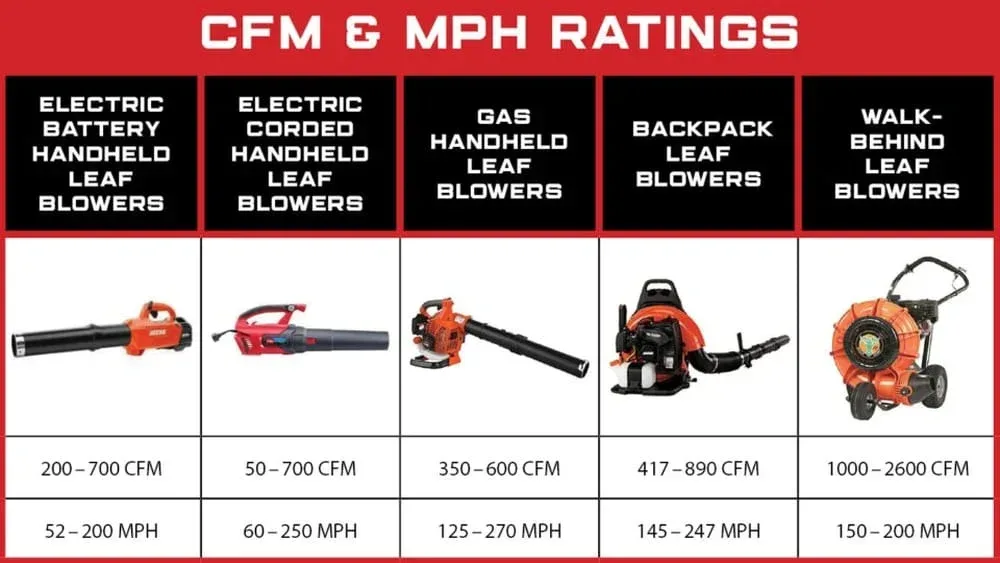
A leaf blower’s CFM, or cubic feet per minute, measures how much air the tool moves. For most U.S. homeowners, a blower with 350 to 500 CFM works well for routine lawn care, while large properties, wet leaves, and heavy debris may need 500 CFM or more.
Use CFM to judge the blower’s ability to move leaves. Use MPH to judge the force of the air stream. The best leaf blower for your yard needs a useful balance of both.
Leaf Blower CFM Chart by Yard and Job Size
The chart below gives practical CFM ranges for common U.S. yard-care tasks. These are planning ranges, not an official performance standard. Actual results depend on the nozzle, leaf moisture, surface, wind, and blower design.
| Yard or job type | Recommended CFM | Typical blower type | Best use |
|---|---|---|---|
| Small patio, porch, or driveway | 100–250 CFM | Compact cordless or corded blower | Dust, grass clippings, and light leaves |
| Small suburban yard | 250–400 CFM | Handheld electric blower | Dry leaves on grass, sidewalks, and driveways |
| Medium residential yard | 350–500 CFM | Strong cordless or gas handheld blower | Regular fall cleanup and heavier leaf cover |
| Large residential yard | 450–650 CFM | High-output cordless, gas handheld, or light backpack blower | Large lawns and deep leaf piles |
| Wet leaves or pine needles | 500–700+ CFM | High-output handheld or backpack blower | Stuck, damp, or dense debris |
| Large property or acreage | 600–900+ CFM | Backpack blower | Long work sessions and heavy leaf loads |
| Commercial or very large areas | 800–2,000+ CFM | Professional backpack or walk-behind blower | Parks, campuses, large lots, and contractors |
Quick interpretation
- Under 250 CFM: Best for light cleanup and hard surfaces.
- 250 to 400 CFM: Suitable for many small residential yards.
- 400 to 600 CFM: A practical range for larger yards and fall leaf cleanup.
- 600 to 900 CFM: Better for wet leaves, thick piles, and long work sessions.
- 900 CFM or more: Usually intended for professional, walk-behind, or specialized equipment.
A higher CFM rating does not always mean a better blower for every homeowner. More airflow can increase weight, noise, battery use, fuel use, and cost.
What Does CFM Mean on a Leaf Blower?
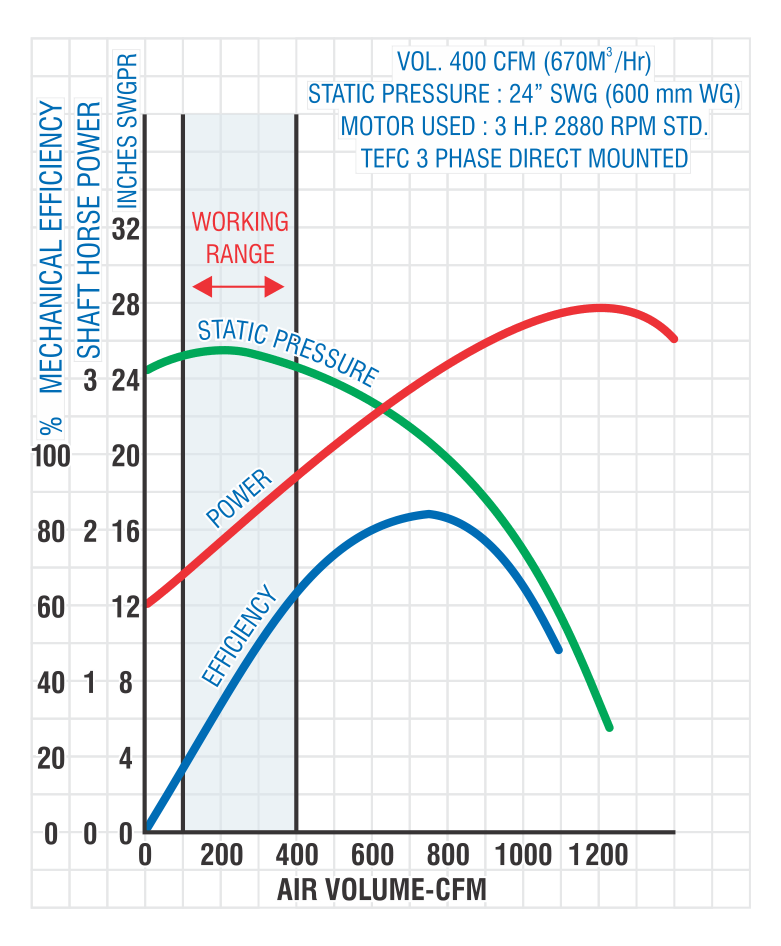
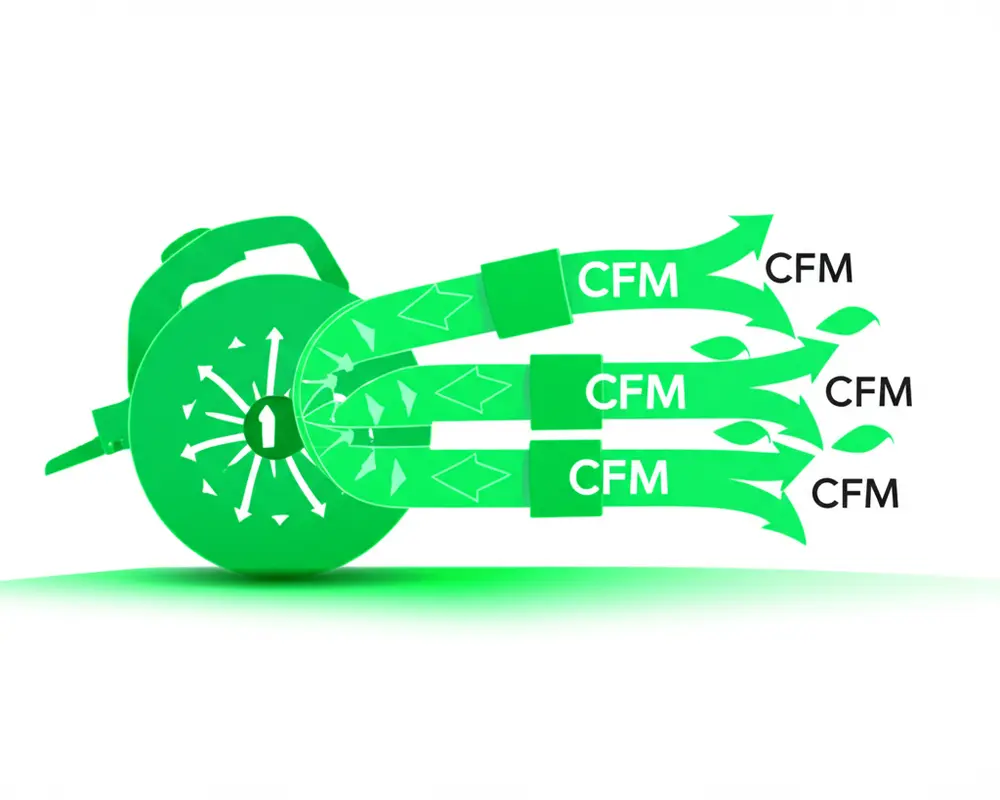
CFM means cubic feet per minute. It tells you the volume of air that passes through the blower in one minute.
Think of CFM as the size of the blower’s invisible broom. A high-CFM blower moves a wider mass of leaves. This helps when leaves cover a large lawn or form deep piles.
CFM is different from MPH:
- CFM: The amount of air moved.
- MPH: The speed of the air stream.
- Air power: A broader performance measure that may combine airflow and air speed.
A blower with high MPH but low CFM may produce a narrow, sharp jet of air. It can be useful for clearing cracks or stubborn debris. A blower with high CFM can move more leaves at once, but it may not push wet leaves unless its air speed is also strong.
CFM and MPH work together
for general yard work, do not compare CFM alone. Check the stated maximum CFM, maximum MPH, and how the manufacturer measured them.
A narrow nozzle often raises MPH by concentrating the air. A wider nozzle may deliver more useful CFM across a broader area. This is why two blowers with similar numbers can feel different in use.
Manufacturers may also report values under different conditions. A rating may represent the blower without a tube, with a specific nozzle, or at a maximum setting. Treat the number as a useful specification, not a guarantee of identical field performance.
How Much CFM Do You Need?
Most homeowners should choose CFM based on four factors: yard size, debris type, surface, and cleanup frequency.
For a small yard
Choose about 200 to 350 CFM for a small lot, patio, porch, or driveway. This range is usually enough for dry leaves, grass clippings, and light debris.
A compact cordless blower may be easier to carry than a larger model. If the blower is used for only a few minutes at a time, a smaller battery may also be sufficient.
For a medium yard
Choose about 350 to 500 CFM for a typical suburban yard. This range offers a useful balance of moving power, weight, and runtime.
It is suitable for:
- Dry leaves on grass
- Sidewalk and driveway cleanup
- Light pine needles
- Grass clippings
- Small leaf piles
If your yard has many mature trees, choose a model near the upper end of this range.
For a large yard
Choose about 450 to 650 CFM for a large lawn or property with heavy seasonal leaf fall. A backpack blower may be more comfortable if cleanup takes more than 20 to 30 minutes.
A higher-output model can reduce the number of passes needed. However, added power does not remove the need to work in sections. Start at the far edge of the property and move debris toward one collection area.
For wet leaves and pine needles
Wet leaves need more force than dry leaves because they stick to grass, pavement, and one another. For regular wet-leaf cleanup, look for about 500 to 700 CFM, along with a strong MPH rating.
Pine needles can also be difficult to move. They may catch in grass or collect in dense mats. A concentrated nozzle and steady sweeping motion may matter as much as the published CFM.
Do not expect any handheld blower to move soaked leaves easily. Waiting for the surface to dry can save time and battery power.
Handheld vs. Backpack Leaf Blower CFM
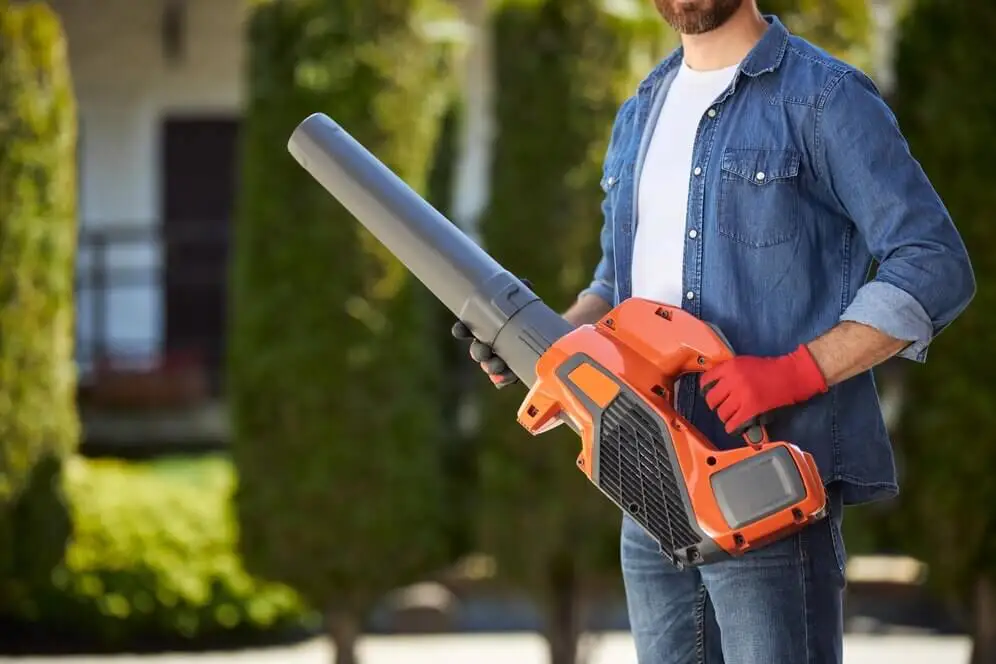
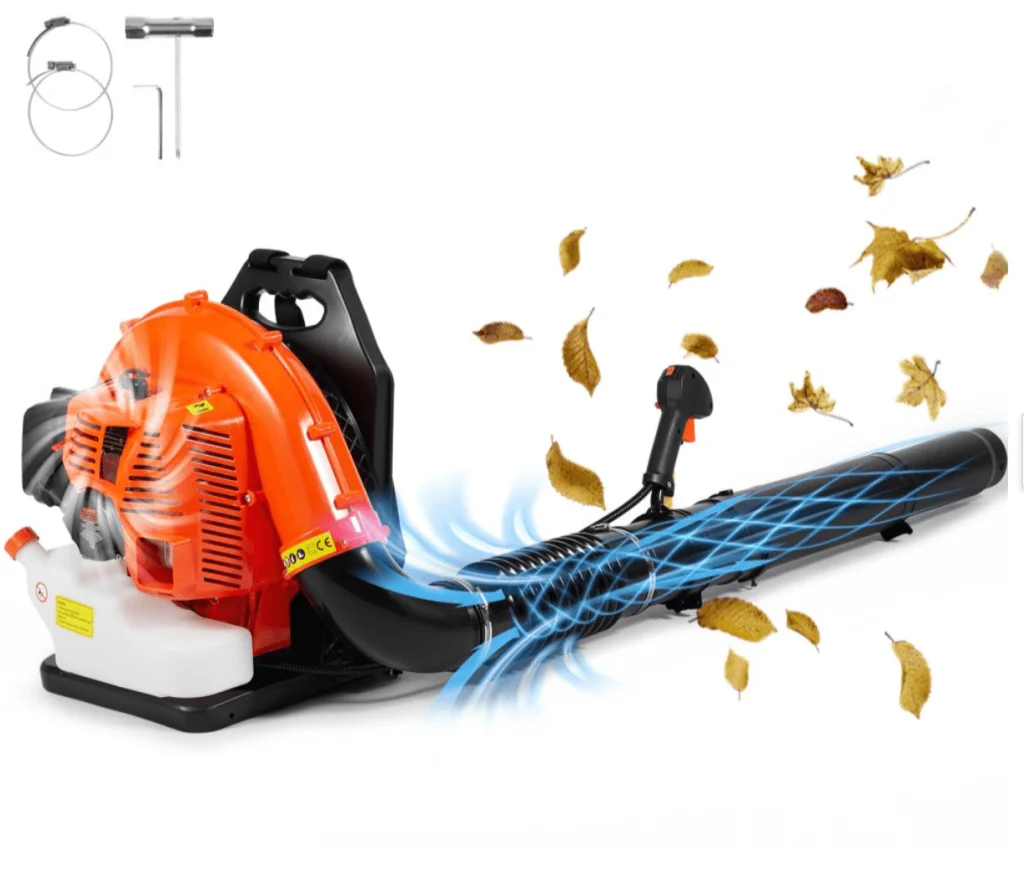
A handheld blower is usually enough for small and medium residential yards. A backpack blower becomes more useful when the work area is large or the cleanup takes a long time.
| Blower type | Common CFM range | Strengths | Limits |
|---|---|---|---|
| Compact cordless | 100–300 CFM | Light, quiet, easy to store | Shorter runtime and less power |
| Corded electric | 150–500 CFM | No fuel and continuous operation | Extension cord limits movement |
| Gas handheld | 300–700 CFM | Strong output and long refueling range | Noise, fuel, emissions, and maintenance |
| Battery backpack | 400–900+ CFM | Comfortable for longer work and strong output | Higher purchase cost and battery weight |
| Gas backpack | 500–1,000+ CFM | High output for large properties | More noise, fuel, exhaust, and maintenance |
| Walk-behind blower | 1,000–3,000+ CFM | Moves large amounts of debris | Bulky and excessive for many home yards |
These ranges overlap because blower design varies widely. A lower-CFM tool with a well-designed nozzle may perform better than a higher-CFM tool with poor air control.
When a backpack blower makes sense
A backpack blower may be worth considering when:
- You clear leaves for more than 30 minutes at a time.
- Your property has many mature trees.
- You move large leaf piles several times each season.
- A handheld blower causes arm or wrist fatigue.
- You need a professional tool for several properties.
For a small lawn, a backpack blower may add weight and noise without providing a meaningful benefit.

CFM vs. MPH: Which Leaf Blower Rating Matters More?
CFM matters more when you need to move a large volume of leaves. MPH matters more when you need to loosen or direct stubborn debris.
Use this simple guide:
| Task | Rating to prioritize | Why |
|---|---|---|
| Moving a broad layer of dry leaves | Higher CFM | Covers more area and moves more material |
| Breaking apart a dense leaf pile | Balanced CFM and MPH | Needs volume and air force |
| Clearing grass clippings | Moderate CFM | Clippings are light and spread easily |
| Removing pine needles | Higher MPH with a focused nozzle | Needles can catch on grass |
| Clearing cracks and corners | Higher MPH | A narrow jet reaches tight spaces |
| Moving wet leaves | High CFM and high MPH | Wet debris needs both volume and force |
Avoid choosing a blower based on the largest number printed on the box. Some manufacturers highlight maximum MPH because it sounds impressive, even though CFM may better represent broad cleanup performance.
A practical comparison example
Imagine two blowers:
- Blower A: 600 CFM and 130 MPH
- Blower B: 450 CFM and 180 MPH
Blower A may move a larger blanket of leaves across a lawn. Blower B may be better at loosening leaves from a tight corner or pushing debris from cracks.
Neither rating proves which blower is better in every situation. The right choice depends on the work.
How to Calculate the Airflow You Need
There is no simple household formula that converts yard size directly into the required leaf blower CFM. Leaf volume, moisture, terrain, nozzle design, and operator technique all change the result.
You can still use a practical selection method:
- Estimate the work area. Separate a small patio from a large lawn.
- Identify the main debris. Dry leaves require less force than wet leaves or pine needles.
- Check the surface. Leaves on pavement are easier to move than leaves caught in grass.
- Choose a CFM range. Use the chart rather than one exact number.
- Compare MPH and nozzle design. A focused nozzle can improve control.
- Check weight and runtime. A powerful blower is less useful if you cannot use it comfortably.
- Confirm the test conditions. Compare specifications measured in a similar way.
Hypothetical example
A homeowner in Ohio has a half-acre lot with several mature oak trees. The main problem is a thick layer of dry leaves on grass and a driveway.
A reasonable starting point would be:
- CFM: 450 to 650
- MPH: At least a moderate-to-high rating
- Type: High-output cordless, gas handheld, or backpack model
- Priority: Runtime and comfort, not maximum MPH alone
The same homeowner may need more power after rain. If the leaves are wet, moving them on a dry day may be more effective than simply buying a larger blower.

Why Leaf Blower CFM Ratings Can Be Misleading
Leaf blower specifications are useful, but they are not always direct comparisons. The measurement may change based on the nozzle, tube, fan setting, and test method.
Watch for these issues:
Maximum CFM is not always operating CFM
A manufacturer may list the highest possible airflow under a specific test condition. The blower may produce less airflow with a narrow tube, battery under load, or partially blocked intake.
Read the full product specification when available. Look for both maximum and rated values.
Vacuum mode may have a different rating
A blower-vac may list one airflow number for blowing and another for vacuuming. Do not assume the vacuum CFM equals the blower CFM.
Vacuum performance also depends on the collection bag, impeller, tube, and the type of debris being collected.
Battery voltage does not equal CFM
A higher battery voltage does not automatically mean higher airflow. Motor design, fan shape, controls, and nozzle design also matter.
Battery capacity affects runtime more directly than peak airflow. A larger amp-hour battery may let you work longer, but it may also add weight.
Noise ratings need context
Noise may be listed in decibels, but the measurement distance and test conditions matter. The Occupational Safety and Health Administration provides general workplace noise guidance, but residential users should still follow the blower manual and wear hearing protection when noise levels are high.
Local rules may limit gas blower use by time, season, or location. Check your city, county, or homeowners association rules before operating one.

Common Leaf Blower CFM Mistakes
The most common mistake is buying the highest CFM model without considering the job. More power can make cleanup faster, but it can also scatter leaves and increase noise.
Avoid these errors:
- Comparing CFM without checking MPH
- Treating maximum ratings as guaranteed field results
- Ignoring wet leaves and dense grass
- Choosing a heavy blower for a small yard
- Using a narrow nozzle when broad airflow is needed
- Using maximum power for every task
- Forgetting battery runtime
- Blowing leaves into streets, storm drains, or neighboring property
- Operating near people, pets, vehicles, or open windows
- Using a gas blower in an enclosed space
Use a sweeping motion rather than pointing the nozzle straight down. Work with the wind when possible. Keep the nozzle low enough to move leaves, but not so low that it blasts soil, mulch, or gravel.
Safety and U.S. Operating Rules
Wear eye protection, hearing protection, sturdy shoes, and long pants when operating a leaf blower. Leaves can hide stones, sticks, and other debris that may become airborne.
Never point the blower at people or animals. Keep children away from the work area. Before clearing a lawn, remove visible rocks, toys, wire, and other loose objects.
For gas models, refuel only when the engine is cool and outdoors. Store fuel in an approved container and follow the engine manual. Never run a gasoline blower in a garage, shed, basement, or other enclosed space because carbon monoxide can build up quickly.
Battery models avoid fuel and tailpipe emissions, but they still require care. Use the charger and battery approved by the manufacturer. Stop using a battery that is swollen, cracked, unusually hot, or damaged.
Local U.S. rules vary. Some communities restrict gas-powered leaf blowers because of noise and air emissions. The U.S. Environmental Protection Agency regulates emissions from small nonroad engines, but local governments may impose additional operating rules.

How to Choose a Leaf Blower From the CFM Chart
Use this short decision process:
- For a patio or driveway: Choose 100 to 250 CFM.
- For a small yard: Choose 250 to 400 CFM.
- For a medium yard: Choose 350 to 500 CFM.
- For a large yard: Choose 450 to 650 CFM.
- For wet leaves or heavy pine needles: Consider 500 to 700+ CFM.
- For large properties: Consider a backpack blower in the 600 to 900+ CFM range.
- For professional cleanup: Compare backpack and walk-behind models above 800 CFM.
Then check the factors that the chart cannot show:
- Air speed and nozzle shape
- Blower weight
- Battery runtime or fuel capacity
- Trigger control and variable-speed settings
- Noise level
- Warranty and service support
- Local restrictions
- Availability of replacement batteries or parts
For most U.S. homeowners, a 350- to 500-CFM blower is the most useful starting point. Move toward 500 to 700 CFM when the property has wet leaves, heavy tree cover, or long cleanup sessions.

Frequently Asked Questions
Is 400 CFM enough for a leaf blower?
Yes. A 400-CFM blower is enough for many small and medium residential yards. It can move dry leaves, grass clippings, and light debris from lawns and hard surfaces. Wet leaves or deep piles may require more airflow and a higher MPH rating.
Is higher CFM always better?
No. Higher CFM can move more leaves, but it may also increase weight, noise, cost, and battery use. Choose enough airflow for your debris and yard size rather than selecting the largest rating.
What is a good CFM for a cordless leaf blower?
A cordless leaf blower with 300 to 500 CFM suits many homeowners. Choose closer to 500 CFM if you have a large yard or heavy fall cleanup. Also check battery runtime, because peak CFM does not tell you how long the blower will operate.
Is CFM or MPH more important?
CFM is usually more important for moving large amounts of leaves. MPH is more useful for loosening debris and directing air into corners. For general cleanup, select a blower with a balanced combination of both ratings.
How much CFM is needed for wet leaves?
A practical starting point is 500 to 700 CFM, combined with a strong air-speed rating. However, very wet leaves may still be difficult to move. Waiting for them to dry can work better than using a larger blower.
What CFM is good for a half-acre property?
For a half-acre property, consider about 500 to 700 CFM if the property has many trees or frequent leaf buildup. A backpack blower may be more comfortable than a handheld model for long sessions.
Can a leaf blower move gravel or mulch?
A powerful blower can move loose gravel, mulch, and soil if the nozzle is held too close or operated at full power. Start at a low setting, keep the nozzle farther away, and test a small area first.
Final Recommendation
Use the leaf blower CFM chart as a starting range, not a promise of exact performance. Choose 250 to 400 CFM for light residential work, 350 to 500 CFM for most medium yards, and 500 to 700+ CFM for wet leaves, heavy debris, or large properties.
Before buying, compare CFM with MPH, nozzle design, weight, runtime, noise, and local U.S. operating rules. The best blower is the one that moves your usual debris without being too heavy, loud, costly, or difficult to control.