

A backpack leaf blower helps clear leaves, grass clippings, and light yard debris from lawns, driveways, sidewalks, and patios across the United States. To use one well, adjust the harness, inspect the machine, start it safely, and direct air in controlled passes rather than blasting debris at random.
The best results come from working with the wind, using the lowest useful throttle, and moving debris toward one planned collection area. Always follow the owner’s manual and check local rules for noise, emissions, and operating hours.
What Is a Backpack Leaf Blower?
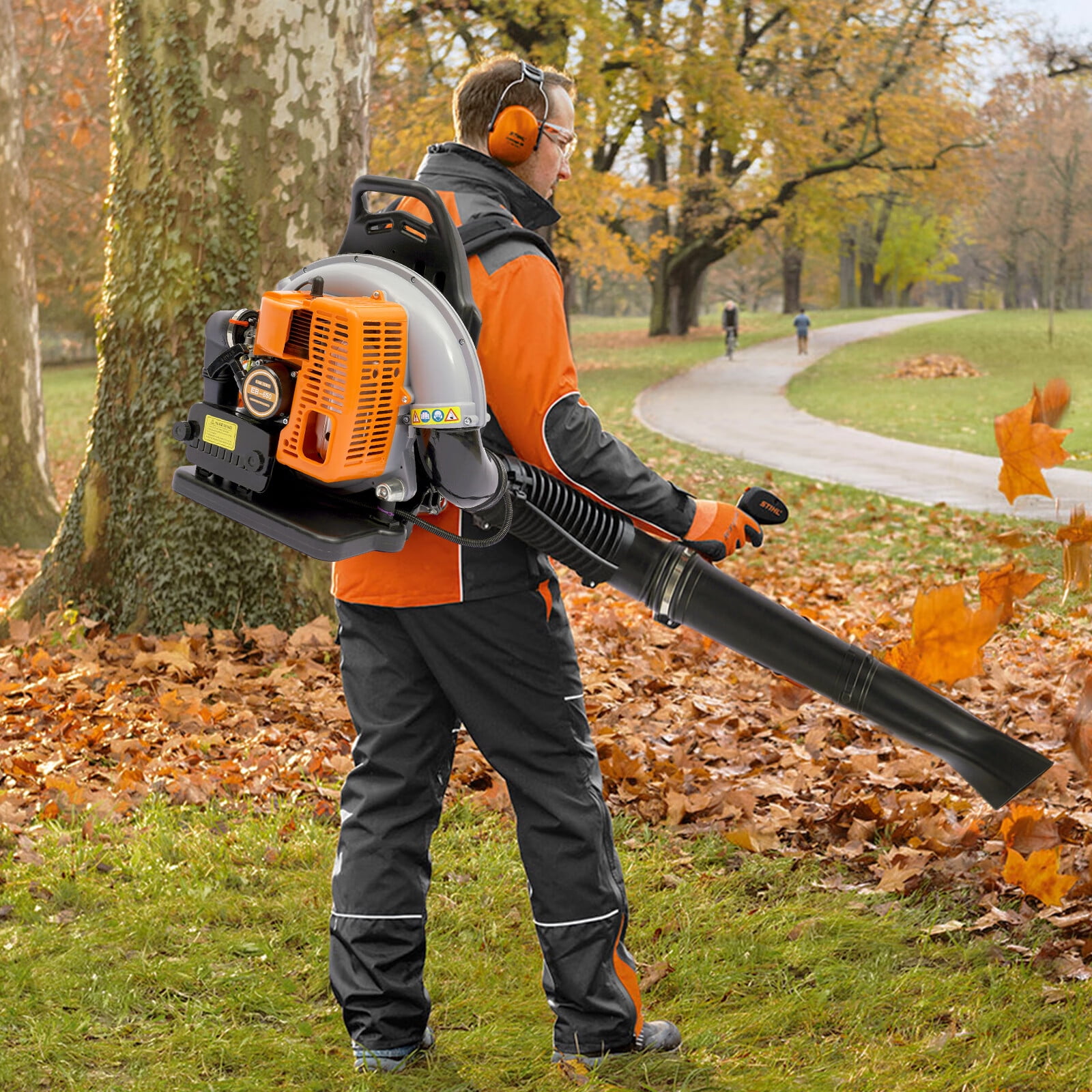
A backpack leaf blower is a portable blower with a padded frame, shoulder straps, a flexible tube, and a handheld control handle. The engine or motor sits on the user’s back, while the nozzle directs a high-speed stream of air.
Most backpack blowers fall into two groups:
- Gas-powered blowers: These use a small two-stroke or four-stroke engine. They usually provide long run time and strong airflow but create exhaust, vibration, and engine noise.
- Battery-powered blowers: These use a rechargeable battery and electric motor. They produce no direct exhaust during use and often start more easily, but run time depends on the battery and operating speed.
- Corded electric blowers: These are less common in backpack form because a power cord limits movement and creates a trip hazard.
Two ratings help describe blower performance:
- Cubic feet per minute (CFM): The volume of air the blower moves.
- Miles per hour (MPH): The speed of the air leaving the nozzle.
CFM helps move a large pile. MPH helps loosen wet leaves, grass, and debris stuck to pavement. Neither number alone proves that one blower will work better in every yard.
Before You Start: Prepare the Blower and Work Area
Inspect the blower, wear protective equipment, and clear the work area before starting the engine or motor. These steps reduce the risk of flying debris, hearing damage, fuel problems, and accidental contact with moving parts.
1. Read the owner’s manual
The manual gives the correct instructions for:
- Fuel and oil mixture, if required
- Battery type and charging method
- Starting and stopping procedures
- Choke and throttle controls
- Nozzle attachment
- Air-filter service
- Spark-plug replacement
- Approved fuel
- Storage requirements
Controls vary by model. Do not assume that a choke, primer bulb, stop switch, or throttle lock works the same way on every backpack blower.
2. Check the machine
With the blower switched off, inspect:
- The blower tube and nozzle
- Clamps, screws, and fasteners
- The air intake screen
- The throttle cable and control handle
- The shoulder straps and waist belt
- The fuel tank and fuel lines on a gas model
- The battery, contacts, and charger on a cordless model
Do not use the blower if the tube is cracked, the throttle sticks, a fuel line leaks, or a safety guard is damaged. Turn the machine off and remove the battery or spark-plug connection before clearing a blockage.
3. Wear suitable protection
At minimum, use:
- Hearing protection
- Safety glasses or sealed eye protection
- Long pants
- Closed-toe shoes with good traction
- Work gloves when handling debris or refueling
A dust mask or respirator may help when dry soil, pollen, or mold is present. Choose respiratory protection based on the hazard. A simple cloth face covering does not provide the same protection as a properly fitted respirator.
The CDC and NIOSH identify loud equipment as a possible source of harmful noise exposure. Gas and high-powered battery blowers can be loud enough that hearing protection is a sensible routine measure.
4. Check the surroundings
Before blowing, look for:
- People, children, and pets
- Open windows and doors
- Vehicles and fragile outdoor items
- Gravel, mulch, and loose soil
- Sticks, stones, and metal objects
- Storm drains and nearby roads
- Dry vegetation or fire risks
Avoid blowing dust or debris toward people, traffic, neighboring property, or open water. Check municipal and homeowners association rules before operating a gas blower or using one during early or late hours.

How to Put On and Adjust a Backpack Leaf Blower
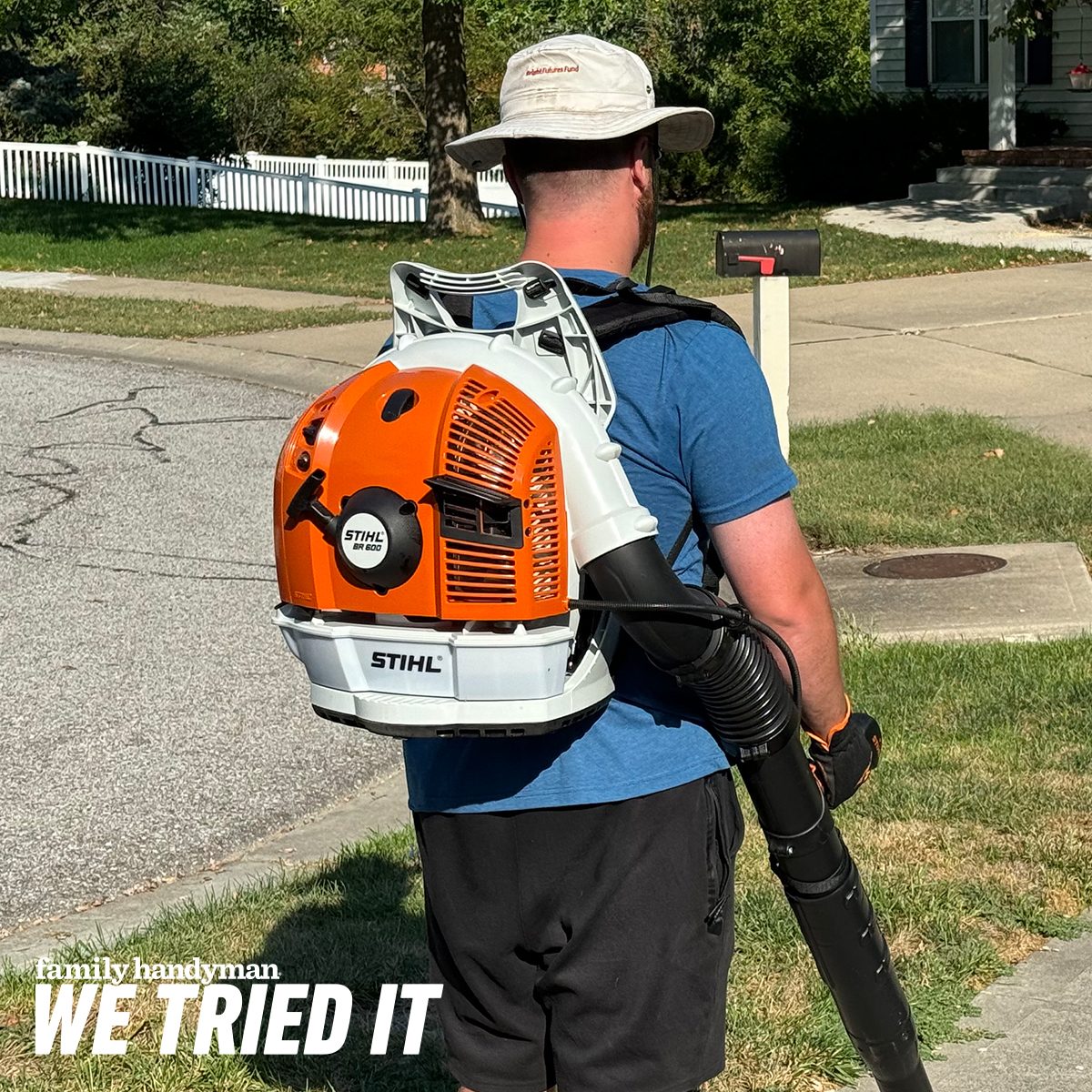
Put the blower on a level surface, slide your arms through the straps, and adjust the frame so it rests close to your back. The waist belt should carry much of the load, while the shoulder straps keep the blower stable.
Use this sequence:
- Set the blower on the ground. Keep the nozzle away from your legs and other people.
- Place your arms through the shoulder straps. Do not start the blower while putting it on.
- Fasten the waist belt. Tighten it so the frame does not swing, but leave enough room for comfortable breathing.
- Adjust the shoulder straps. Pull them evenly until the blower sits upright and close to your back.
- Check the control handle. Your wrist should remain in a neutral position. You should not need to twist your shoulder to reach the throttle.
- Position the blower tube. Aim the nozzle slightly downward and away from your body.
- Walk a few steps with the blower off. Make sure the frame does not shift and the straps do not restrict movement.
A poor fit causes fatigue and makes the nozzle harder to control. If the machine pulls to one side, stop and readjust the straps, tube, or control handle.
How to Start a Gas Backpack Leaf Blower
Start a gas backpack blower outdoors, away from doors, windows, garages, and other enclosed spaces. Gas engines produce carbon monoxide, an odorless gas that can build up quickly indoors.
The exact sequence depends on the model, but the usual method is:
- Place the blower on stable ground.
- Confirm that the stop switch is in the run position.
- Press the primer bulb the number of times stated in the manual.
- Move the choke to the cold-start position if the engine is cold.
- Hold the blower firmly or secure it so it cannot move.
- Pull the starter cord with a smooth, controlled motion.
- Once the engine starts, move the choke toward the run position as the engine warms.
- Let the engine run briefly at a low speed before using full throttle.
Do not pull the starter cord while the blower is on your back unless the manual specifically permits that method and you can do it safely. Many users have better control when they start the machine on the ground.
If the gas blower will not start
Stop repeated attempts after a few pulls. Then check:
- The stop switch
- The fuel level
- Whether the fuel is fresh and correctly mixed
- The choke position
- A flooded engine
- The spark-plug condition
- A blocked air filter
Never service a hot engine or inspect fuel leaks near a flame, spark, cigarette, or other ignition source. For persistent problems, use the manufacturer’s service procedure or a qualified small-engine technician.
How to Start a Battery Backpack Leaf Blower
A battery model usually starts with less effort, but the battery must be charged and correctly installed.
- Charge the battery with the approved charger.
- Inspect the battery for cracks, swelling, heat damage, or wet contacts.
- Install the battery until it locks in place.
- Confirm that the tube and nozzle are attached.
- Press the power button or unlock switch.
- Squeeze the variable-speed trigger gradually.
- Use the lowest setting that moves the debris.
Do not use or charge a battery that is swollen, cracked, unusually hot, wet, or damaged. Follow the battery maker’s storage instructions, especially during very hot or cold weather.
Battery run time changes with temperature, battery age, nozzle design, debris weight, and throttle setting. Full power is useful for stuck or wet leaves, but it can shorten work time sharply.
How to Use a Backpack Leaf Blower Step by Step
Use a backpack leaf blower by directing air low and forward, working in planned sections, and gathering debris into small piles. Do not aim the nozzle straight down at close range because that can scatter dust and bury debris in grass or mulch.
Step 1: Plan the collection area
Choose where the leaves will go before you start. Suitable destinations may include:
- A tarp
- A compost pile
- Yard-waste bags
- A municipal leaf-collection area
- A designated curbside pickup area
Keep the collection point away from storm drains. Leaves and grass clippings can block drainage and add organic pollution to waterways.
Step 2: Work with the wind
If possible, position yourself so the natural wind helps move debris in the same direction as the blower. Avoid creating a dust cloud that travels back toward you.
If the wind is strong or changes direction, use smaller sections. A large pile can spread quickly when the air stream and wind oppose each other.
Step 3: Hold the nozzle at the correct angle
Keep the nozzle about a few inches above the surface. Aim slightly forward and use a shallow angle.
- On pavement, sweep the nozzle across the surface.
- On grass, avoid scraping the nozzle through the turf.
- Near mulch, reduce throttle to prevent scattering mulch.
- Around gravel, use short bursts and a higher nozzle position.
- Near flower beds, aim away from plants and soil.
Step 4: Use a side-to-side motion
Move the nozzle in a slow arc rather than holding it in one place. Start at the outside edge of the work area and push debris inward.
For a lawn, use overlapping passes:
- Clear one strip.
- Move a few feet to the next strip.
- Push the second strip toward the first.
- Continue until the debris forms a manageable row.
- Move the row to the final collection point.
Step 5: Use the lowest effective throttle
Higher throttle is not always better. Excess air can:
- Scatter leaves in several directions
- Strip mulch from beds
- Expose bare soil
- Raise dust and allergens
- Blow debris into roads or neighboring yards
- Reduce battery run time
- Increase noise
Increase power only when lower power cannot move the debris. Wet leaves may need more force, while dry leaves usually move with less.
Step 6: Finish with a hand tool when needed
A blower is not a substitute for every tool. Use a rake, broom, or hand vacuum for:
- Leaves trapped in dense shrubs
- Heavy wet piles
- Debris in tight corners
- Gravel mixed with leaves
- Material close to people or fragile objects
A short hand cleanup can be safer and faster than trying to solve every problem with full blower power.

How to Blow Leaves on Different Surfaces
The surface changes the best nozzle height, throttle, and direction. Use controlled air to move debris without damaging the surface or spreading dust.
| Surface | Recommended approach | Main risk |
|---|---|---|
| Lawn | Use a low-to-medium setting and shallow angle | Scattering leaves or drying bare soil |
| Concrete | Sweep across the surface with steady passes | Blowing dust into the air |
| Asphalt | Use moderate power and avoid loose edges | Moving gravel into traffic areas |
| Gravel | Raise the nozzle and use short bursts | Throwing stones |
| Mulch | Use low power and aim away from beds | Removing mulch |
| Flower beds | Work from the edge outward | Damaging plants |
| Decks and porches | Use low power near screens and trim | Forcing debris into gaps |
| Gutters | Use only approved attachments and safe access | Falls and roof damage |
Never use a backpack blower to clean a roof while standing on a ladder unless the equipment and procedure are designed for that use. A blower can affect balance, and wet roofs are especially dangerous.
How to Stop and Store a Backpack Leaf Blower
Stop the blower before setting it down, removing the harness, clearing debris, or making adjustments.
For a gas blower:
- Release the throttle.
- Let the engine return to idle.
- Move the stop switch to off.
- Place the blower on a stable, nonflammable surface.
- Let the engine cool before refueling or storing.
- Wipe away dirt from the air intake and exterior.
- Store fuel only as directed by the manufacturer.
For a battery blower:
- Release the trigger.
- Switch the blower off.
- Remove the battery.
- Inspect the tube and air intake.
- Store the battery in the temperature range listed in its manual.
- Keep the battery and blower dry.
For seasonal storage, gas models may require fuel treatment or fuel-system draining. Battery models may need the battery stored at a partial charge. The correct procedure varies by manufacturer, so use the manual rather than a general rule.

Common Problems and Quick Fixes
Most blower problems come from an incorrect setting, a blocked intake, poor fuel, a low battery, or an unsafe work method. Check simple and safe causes first.
| Problem | Likely cause | What to do |
|---|---|---|
| Leaves will not move | Low power, wet debris, poor nozzle angle | Increase power slightly and lower the nozzle angle |
| Leaves scatter everywhere | Too much throttle or wind | Use smaller passes and lower power |
| Dust blows back at you | Wind direction or dry soil | Change position, reduce power, or dampen dust if appropriate |
| Blower vibrates | Loose tube, damaged fan, or debris | Stop the machine and inspect it |
| Gas engine dies at full throttle | Blocked filter, stale fuel, or fuel issue | Check the manual and service the engine |
| Battery runs out quickly | Old battery, cold weather, or constant full power | Use a lower setting and check battery condition |
| Harness causes pain | Poor strap adjustment or uneven load | Tighten the waist belt and balance the shoulder straps |
| Blower overheats | Blocked air intake or excessive load | Stop, cool the unit, and clear the intake safely |
If the impeller, fan, or internal parts appear damaged, do not keep operating the blower. A damaged rotating part can fail at high speed and throw fragments.
Safety Rules That Matter Most
Use a backpack blower only when you can control the air stream and see the work area. Stop immediately if people, animals, vehicles, or unsafe conditions enter the area.
Follow these rules:
- Never operate a gas blower indoors, in a garage, or near an open building entrance.
- Do not point the nozzle at people, animals, windows, vehicles, or roads.
- Keep children and bystanders away from flying debris.
- Avoid operation during lightning, extreme heat, or poor air quality.
- Do not smoke or create sparks while handling fuel.
- Keep hands and clothing away from the intake and moving parts.
- Do not modify the muffler, emissions equipment, battery, or safety controls.
- Check local restrictions on gas-powered blowers, noise, and operating hours.
- Stop work if you develop ringing ears, dizziness, breathing trouble, or unusual fatigue.
The U.S. Environmental Protection Agency regulates emissions from many nonroad engines, but local rules can be stricter. State and city requirements may differ, so verify the rules that apply to your property.

When Should You Use a Rake Instead?
Use a rake or broom when the area is small, debris is close to people or fragile items, or noise and dust are major concerns. A blower is most useful for broad surfaces and large amounts of loose debris.
A rake may be the better choice when:
- Leaves are wet and heavy
- Gravel is mixed with the debris
- The area contains loose mulch
- Neighbors are close by
- Dust could affect someone’s breathing
- The work area is near an open road
- You need precise control
A practical approach is to blow large open areas first, then finish edges and delicate spaces with a rake or broom.
Frequently Asked Questions
Can you use a backpack leaf blower on wet leaves?
Yes, but wet leaves are heavier and may stick to grass or pavement. Use a controlled, higher setting and move smaller sections. If the leaves form a thick mat, rake or break them apart first.
How long can you run a backpack leaf blower?
The safe run time depends on the model, weather, fuel or battery capacity, and throttle setting. Take breaks to reduce noise and fatigue. Stop if the engine overheats, the battery becomes unusually hot, or you lose control of the nozzle.
Should you use full throttle with a backpack blower?
No. Use the lowest setting that moves the debris. Full throttle may be needed for wet or stuck material, but lower power usually gives better control and reduces noise, dust, fuel use, or battery drain.
Can a backpack leaf blower damage grass?
It can disturb bare soil, dry loose material, or scatter mulch if you hold the nozzle too close or use excessive power. Keep the nozzle slightly above the ground and use a shallow angle with moderate throttle.
Is it safe to use a gas leaf blower in a garage with the door open?
No. Do not run a gas blower in a garage, shed, or other partly enclosed space. Carbon monoxide can build up even when a door is open. Start and operate the blower outdoors, away from openings.
What should you do if the blower hits a rock?
Release the throttle and shut the blower off. Inspect the nozzle, tube, intake, fan area, and housing for damage. Do not resume work if the machine vibrates, makes a new noise, or has a cracked part.
Conclusion
To use a backpack leaf blower well, prepare the machine, wear hearing and eye protection, adjust the harness, and start it outdoors according to the manual. Work with the wind, aim the nozzle low and forward, use controlled passes, and choose the lowest throttle that moves the debris.
Stop when conditions become unsafe, keep debris away from roads and people, and use a rake or broom for wet, delicate, or confined areas. Your next step is to inspect the blower and work area, choose a collection point, and test the lowest useful power setting on a small section.