

To start a gas leaf blower, move it outdoors, check the fuel and controls, set the choke, press the primer bulb if fitted, and pull the starter cord until the engine runs. Then move the choke to the run position and let the engine warm up before using the throttle.
The exact steps vary by model. Always follow the starting diagram in your owner’s manual, especially for the fuel mix, choke setting, primer use, and stop switch. This guide applies to common gas-powered leaf blowers used by homeowners in the United States.

Before Starting a Gas Leaf Blower
A short safety check can prevent fire, engine damage, and hard starting. Place the blower on firm ground outdoors, away from dry leaves, gasoline spills, buildings, and other ignition sources.
1. Read the starting instructions
Find the model number on the blower housing and review the owner’s manual. Look for instructions about:
- Fuel type
- Gas-to-oil ratio
- Choke positions
- Primer bulb use
- Throttle lock settings
- Starting and stopping procedures
Some blowers use a two-cycle engine. Others use a four-cycle engine. Their fuel requirements are not the same.
2. Check the fuel
Most small gas leaf blowers use one of these systems:
| Engine type | Fuel requirement |
|---|---|
| Two-cycle engine | Gasoline mixed with two-cycle engine oil at the ratio listed in the manual |
| Four-cycle engine | Straight gasoline in the fuel tank and separate engine oil in the crankcase |
Never put straight gasoline into a two-cycle engine. It may run briefly, but the engine can suffer severe damage because the gasoline does not provide the oil needed for lubrication.
Use fresh, clean gasoline that matches the manufacturer’s instructions. In the United States, many small-engine manufacturers warn against gasoline containing more than 10% ethanol, often labeled E15 or higher. The U.S. Environmental Protection Agency states that E15 is not approved for use in most small gasoline engines.
Do not use gasoline that is old, cloudy, contaminated, or mixed with water. If the fuel has been stored for a long period, drain it only as directed by the manufacturer and use approved fuel-storage practices.
3. Inspect the blower
Before starting, check that:
- The blower tube is attached correctly.
- The air filter cover is closed.
- The fuel cap is tight.
- The starter cord is not frayed.
- The throttle moves freely.
- The stop switch is in the On, Run, or I position.
- No fuel is leaking.
- The intake is clear of leaves and debris.
Wear eye protection, hearing protection, long pants, sturdy shoes, and close-fitting clothing. Do not start or operate a gas blower indoors, inside a garage, or near an open window.
How to Start a Cold Gas Leaf Blower
A cold engine has not run recently and needs a richer fuel mixture to start. The choke helps provide that mixture.
Follow these steps for a typical carbureted gas leaf blower:
- Place the blower on the ground. Keep the blower tube pointed away from people, animals, windows, and loose objects.
- Set the stop switch to Run or On.
- Press the primer bulb. Press it slowly several times until fuel moves through the clear fuel line or the bulb feels full. The correct number varies by model, so use the manual’s number. Do not keep pressing if the bulb is already full.
- Move the choke to the closed or full-choke position. This setting is usually marked with a choke symbol.
- Hold the blower firmly. Place one hand on the handle and use your foot or other hand to keep the unit steady, if the manual allows it.
- Pull the starter handle slowly until you feel resistance. Then pull it firmly and smoothly. Let the cord return slowly instead of releasing it.
- Listen for the first start or “pop.” The engine may fire for a moment and stop. This is normal on many models.
- Move the choke to the half-choke or open position. Do this as directed in the manual.
- Pull the starter again. The engine should start and continue running.
- Move the choke fully open or to Run. Let the engine warm for a short time before using full throttle.
Do not pull the starter cord to its full length or snap it back into the housing. Those actions can damage the recoil starter.
What a successful start looks like
A properly started blower should:
- Run without repeated stalling
- Respond to the throttle
- Produce a steady engine sound
- Keep the blower tube attached and clear
- Show no fuel leaks or unusual smoke
A small amount of smoke may occur when a two-cycle engine starts, especially if the fuel mix is oil-rich. Heavy smoke, a strong fuel smell, or fuel dripping from the carburetor requires you to stop and inspect the machine.

How to Start a Warm Gas Leaf Blower
A warm engine usually needs less fuel enrichment than a cold engine. Using full choke on a warm engine can flood it.
For a typical warm start:
- Place the blower outdoors on stable ground.
- Set the stop switch to Run or On.
- Leave the choke open, or use the warm-start position shown in the manual.
- Press the primer bulb only if the manual tells you to do so.
- Pull the starter handle with firm, smooth strokes.
- Move the throttle gradually after the engine starts.
If the engine ran only a few minutes earlier, treat it as warm. If it has been sitting for several hours, use the cold-start procedure unless the manual gives a different instruction.
Starting a flooded engine
An engine may flood when too much fuel enters the cylinder. Common signs include a strong gasoline smell, no start after many pulls, or a wet spark plug.
To clear a flooded engine:
- Move the blower outdoors and away from flames.
- Set the choke to Open, Run, or Off.
- Do not press the primer bulb.
- Hold the throttle fully open if the manual permits it.
- Pull the starter several times.
- Once the engine starts, release the throttle gradually.
Do not remove the spark plug near gasoline vapors or other ignition sources. If the engine still will not start, allow the blower to sit and have the spark plug and fuel system checked.

How to Start a Gas Leaf Blower Without Flooding It
The best way to prevent flooding is to use the choke only when the engine is cold and to stop priming when the manual’s instructions are complete.
Use these habits:
- Do not pump the primer bulb repeatedly after it is full.
- Do not use full choke on a warm engine.
- Do not pull the starter endlessly with the choke closed.
- Move the choke toward open after the engine first fires.
- Use the correct fuel mix.
- Keep the air filter clean.
- Replace stale fuel according to the manufacturer’s instructions.
A common mistake is to assume that more priming will make the engine start faster. It often does the opposite. The primer moves fuel into the carburetor, so excessive priming can create a mixture that is too rich to ignite.
What to Do If the Gas Leaf Blower Will Not Start
Check the simplest and safest causes first. Avoid taking apart the carburetor until you have checked the fuel, switch, choke, and spark plug.
| Symptom | Likely cause | Safe first check |
|---|---|---|
| No sound or engine movement | Stop switch is off or starter problem | Set the switch to Run and inspect the starter cord |
| Engine does not fire | Empty tank, stale fuel, closed fuel path, or no spark | Check fuel level, fuel age, and the manual’s starting steps |
| Engine fires but stops | Choke remains closed or engine is not warm | Open the choke after the first start |
| Strong gasoline smell | Flooded engine | Stop priming and use the flooded-engine procedure |
| Engine runs poorly | Old fuel, blocked air filter, dirty spark plug, or incorrect fuel mix | Stop the engine and inspect the filter and fuel |
| Engine starts but dies under throttle | Fuel restriction or dirty carburetor | Check the air filter and fuel system; seek service if needed |
| Starter cord will not pull | Engine may be seized or recoil starter may be damaged | Do not force the cord; arrange qualified service |
Check the fuel mix
For a two-cycle blower, the oil-to-gas ratio must match the manual. Common ratios include 50:1, but you must not assume that every blower uses the same ratio.
For a 50:1 mixture:
- 1 U.S. gallon of gasoline requires 2.6 fluid ounces of two-cycle oil.
- 2 U.S. gallons require 5.1 fluid ounces.
- 1 liter of gasoline requires 20 milliliters of oil.
These are calculated examples, not a substitute for the manufacturer’s specified ratio. Use a marked fuel container and mix fuel in the correct order and amount.
Check the air filter
A dirty air filter limits airflow. The engine may start but run poorly, smoke, or stop when you press the throttle.
Clean or replace the filter as the manual directs. Do not operate the blower without its filter unless the manufacturer specifically permits that service step. Dirt entering the engine can cause wear.
Check the spark plug
A fouled, wet, or damaged spark plug can prevent ignition. Stop the engine, let it cool, disconnect the spark-plug wire, and inspect the plug only if the manual provides that procedure.
Replace the plug with the correct type and gap. Do not guess the gap or use a plug that merely appears to fit.
Know when to stop troubleshooting
Stop and seek qualified small-engine service if:
- Fuel leaks from the tank, line, or carburetor.
- The starter cord is damaged.
- The engine locks or the cord will not move.
- The blower backfires repeatedly.
- You see smoke from the housing.
- The stop switch does not shut off the engine.
- You are unsure how to work on the ignition or fuel system.

Gas Leaf Blower Starting Safety in the United States
Gasoline vapors can ignite easily. Start and refuel the blower outdoors, away from cigarettes, grills, pilot lights, sparks, and hot surfaces.
Follow these safety rules:
- Never start a gas blower inside a home, garage, shed, or enclosed trailer.
- Refuel only when the engine is cool.
- Wipe up spilled fuel before starting.
- Keep children and pets away from the work area.
- Never point the blower at people, animals, vehicles, or windows.
- Avoid blowing dust, gravel, glass, or metal fragments.
- Use hearing protection because gas blowers can produce high noise levels.
- Follow local rules for gas-blower use, noise, emissions, and seasonal restrictions.
- Store fuel in an approved container and follow local fire-safety rules.
The Occupational Safety and Health Administration warns about the dangers of gasoline and ignition sources in workplace settings. The Consumer Product Safety Commission also provides safety information for outdoor power equipment and fuel handling. Residential users should still follow the exact warnings in their blower’s manual.
Two-Cycle vs. Four-Cycle Gas Leaf Blowers
The starting steps may look similar, but the fuel systems differ.
Two-cycle blowers
Two-cycle engines use a gasoline-and-oil mixture. They are common in handheld gas blowers because they are compact and light.
Their main starting risks are:
- Using the wrong oil ratio
- Using straight gasoline
- Using the wrong type of oil
- Leaving the choke closed too long
- Mixing fuel incorrectly
Four-cycle blowers
Four-cycle engines use straight gasoline in the fuel tank and separate engine oil in the crankcase. They may require oil checks before operation.
Their main starting risks are:
- Running with low engine oil
- Using stale gasoline
- Forgetting the correct choke position
- Failing to follow the oil-level instructions
Never assume that fuel instructions from one blower apply to another. Engine design, carburetor setup, and control layout can differ even among models from the same brand.
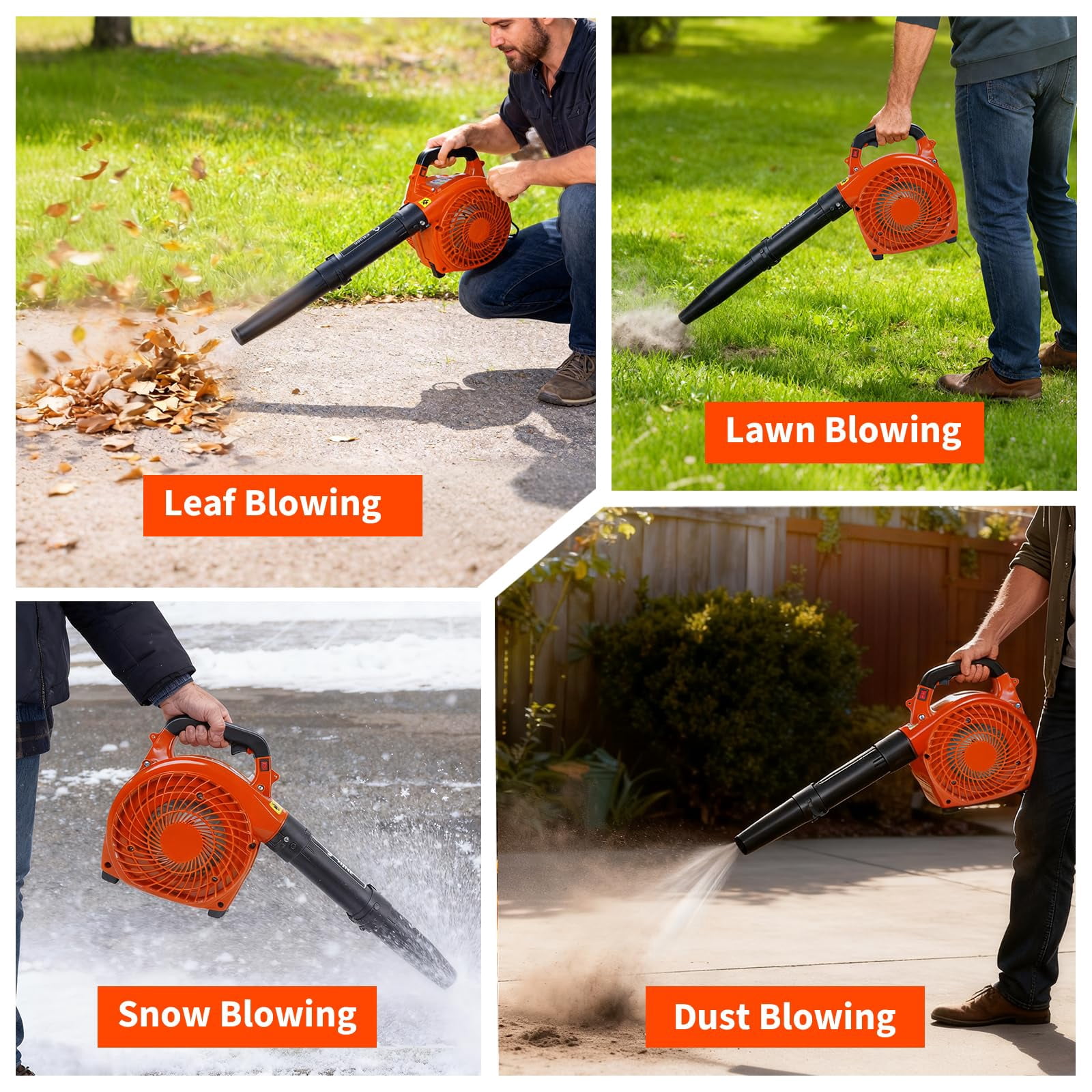
When to Use a Different Tool
A gas leaf blower may not be the best choice for every yard or task. Consider a battery blower when you need lower maintenance, easier starting, or use in an area with strict gas-equipment rules.
A rake may be better for a small yard, wet leaves, or areas where blowing dust could affect neighbors. A vacuum or mulcher may be more useful when you need to collect leaves rather than move them.
Your choice depends on yard size, debris type, local rules, noise limits, storage space, and whether you want to maintain a fuel-powered engine.
Key Takeaways
- Start a gas leaf blower outdoors on stable ground.
- Check the fuel type and use the exact mix listed in the manual.
- Use full choke only for a cold engine.
- Prime the engine only as directed.
- Move the choke open after the engine first fires.
- Do not force the starter cord or keep pulling with a flooded engine.
- Stop if you find a fuel leak, damaged cord, smoke, or an engine that will not shut off.
- Follow U.S. fuel, noise, emissions, and local-use rules.
Frequently Asked Questions
Why will my gas leaf blower not start after winter storage?
Old fuel, a dirty carburetor, a blocked fuel line, a fouled spark plug, or a damaged fuel primer can cause this problem. Drain or replace the fuel only as directed by the manual, then inspect the air filter and spark plug. A carburetor that has varnish buildup may need professional cleaning.
Should I press the primer bulb before every start?
Usually, the primer is mainly needed for a cold start. Some models require a few presses after sitting, while others do not. Follow the instructions printed on the blower or in the owner’s manual.
Can I use regular gasoline in a two-cycle leaf blower?
Only if it is mixed with the correct two-cycle oil at the manufacturer’s stated ratio. Straight gasoline can cause serious engine damage because it does not provide enough lubrication.
How many times should I pull the starter cord?
There is no universal number. Pull until the engine first fires, then change the choke as directed. If you keep pulling with full choke, you may flood the engine.
Why does my leaf blower start and then die?
The choke may still be closed, the engine may be flooded, or the blower may have stale fuel, a blocked air filter, a dirty spark plug, or a fuel-flow problem. Begin with the choke and fuel checks before removing engine parts.
Can I start a gas leaf blower while holding it?
Only if the owner’s manual specifically allows that method. Starting it on the ground gives you better control and keeps the intake and tube away from your body.
Conclusion
Starting a gas leaf blower is usually simple: check the machine, use the correct fuel, prime the cold engine, set the choke, pull the starter smoothly, and open the choke once the engine fires.
If the blower does not start, avoid random adjustments. Check the switch, fuel, choke, primer, air filter, and spark plug in that order. When you find a leak, damaged starter, locked engine, or unsafe electrical or ignition problem, stop and use qualified small-engine service.
Sources for U.S. safety and fuel guidance
- U.S. Environmental Protection Agency: Fuels and fuel additives
- Occupational Safety and Health Administration: Flammable liquids
- U.S. Consumer Product Safety Commission: Outdoor power equipment safety
- The owner’s manual for the specific gas leaf blower model remains the primary source for fuel ratio, choke position, primer use, and starting steps.