
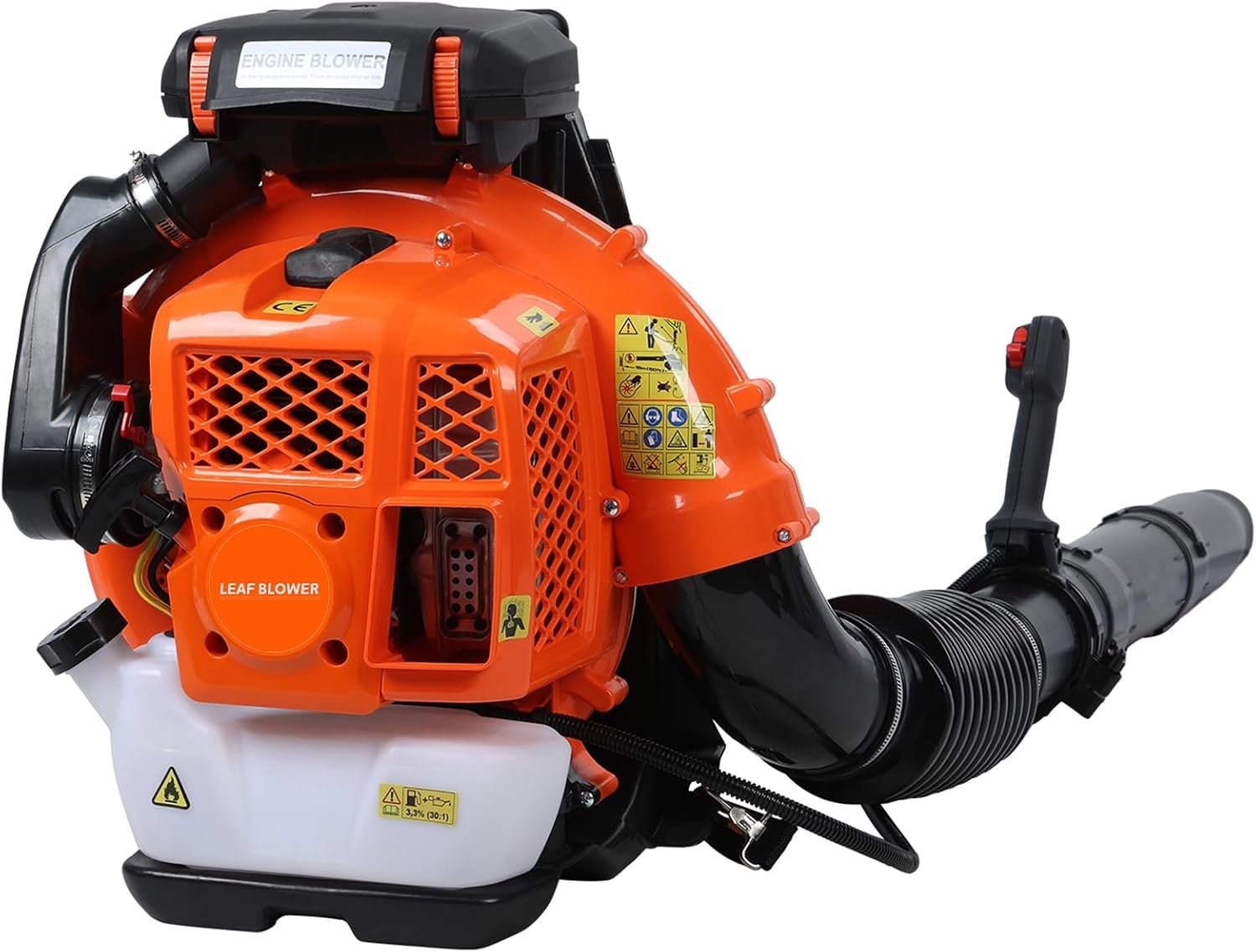
A gas leaf blower usually lasts 5 to 10 years for a U.S. homeowner when it gets regular care. A lightly used, well-stored blower may run for 10 years or more. A commercial blower used for many hours each week may need major repairs sooner, often within 2 to 5 years.
The engine’s total run time matters more than its calendar age. Clean fuel, fresh spark plugs, a clean air filter, correct storage, and prompt repairs can greatly extend the life of a gas leaf blower. Poor fuel storage, overheating, dust, and neglected maintenance can shorten it.

Average Gas Leaf Blower Lifespan
Most gas leaf blowers do not have a fixed expiration date. Their useful life depends on engine quality, operating hours, climate, storage, and maintenance.
These ranges are practical estimates rather than a guaranteed rating from every manufacturer:
| Use pattern | Typical service life | What affects the result |
|---|---|---|
| Occasional homeowner use | 8–10+ years | Low annual hours and good storage |
| Regular homeowner use | 5–8 years | Seasonal use and routine maintenance |
| Heavy homeowner use | 3–6 years | Large lots, long sessions, frequent operation |
| Landscaping or commercial use | 2–5 years | High hours, dust, transport, and daily starts |
| Poorly maintained use | 1–3 years | Old fuel, blocked filters, overheating, and neglect |
A blower that is 10 years old but has low operating hours may be in better condition than a three-year-old blower used every day. For this reason, age alone does not show how much life remains.
Manufacturers often provide a warranty for a limited period, such as two years for consumer use or a different term for commercial use. A warranty period is not the same as the expected lifespan. It mainly shows how long the manufacturer agrees to cover certain defects under stated conditions.
The most useful measure is engine hours. Unfortunately, many handheld gas blowers do not include an hour meter. You may need to estimate use from your seasonal routine, service records, or the blower’s overall condition.

What Determines How Long a Gas Leaf Blower Lasts?
The main factors are fuel quality, maintenance, workload, storage, and build quality. These factors often matter more than the brand name printed on the housing.
Fuel and oil quality
Old gasoline is one of the most common causes of hard starting and poor engine life. Small two-stroke engines use a gasoline-and-oil mixture. If the mix is too lean, too rich, too old, or made with the wrong oil, the engine may suffer poor lubrication, carbon buildup, or internal damage.
Use the fuel type and oil ratio listed in the owner’s manual. Do not guess the ratio. Common two-stroke ratios include 50:1, but the correct ratio depends on the engine.
The U.S. Environmental Protection Agency regulates gasoline standards, and many gasoline products in the United States contain ethanol. Ethanol-blended fuel can attract moisture during storage. Follow the blower manufacturer’s instructions for fuel type, storage time, and fuel stabilizer.
Maintenance habits
Regular maintenance protects the parts that control air, fuel, ignition, and cooling. important service items include:
- Air filter cleaning or replacement
- Spark plug inspection and replacement
- Fuel filter replacement when required
- Fuel-line inspection
- Cooling-fin cleaning
- Muffler and spark-arrestor inspection
- Correct two-stroke fuel mixing
- Carburetor adjustment by a qualified technician when needed
A dirty air filter can restrict air flow and make the engine run poorly. A clogged cooling area can raise engine temperature. A worn spark plug can cause hard starts and incomplete combustion.
Workload and operating conditions
A blower used for 15 minutes each month faces less wear than one used for several hours every workday. Heavy loads also increase stress. Moving wet leaves, gravel, thick debris, or large piles may require longer run times and more throttle.
Dusty yards can clog filters and cooling passages quickly. Hot weather can increase heat stress. Steep properties may also require longer operation than small, flat yards.
Storage
Storage has a major effect on long-term reliability. Gas left in the carburetor can become stale and leave deposits. Moisture can also damage fuel-system parts.
For seasonal storage, follow the owner’s manual. The instructions may call for draining the fuel, running the engine dry, adding approved fuel stabilizer, or storing the blower with fresh treated fuel. Do not use a storage method that conflicts with the manual.
Build quality and repair support
Commercial-grade blowers may have stronger parts and better support, but they also cost more. A higher purchase price does not guarantee a specific lifespan.
A blower can last longer when replacement parts are available. Check whether the manufacturer still supports common items such as filters, spark plugs, fuel lines, starter assemblies, tubes, and carburetors.

Signs Your Gas Leaf Blower Is Near the End of Its Life
A single problem does not always mean you need a new blower. Many starting and power issues come from inexpensive service parts or stale fuel.
Look for these warning signs:
- The engine is hard to start after basic fuel and spark checks.
- The blower loses power under normal load.
- The engine stalls repeatedly at idle or full throttle.
- The motor surges even with fresh, correctly mixed fuel.
- It produces heavy smoke that does not clear after proper operation.
- The engine overheats or shuts down.
- Fuel leaks from the tank, lines, or carburetor.
- The starter rope, crankshaft, or fan vibrates abnormally.
- The blower makes knocking, grinding, or sharp metallic sounds.
- The housing, fuel tank, or tube has serious cracks.
- Repairs cost close to the price of a comparable replacement.
Fuel leaks deserve special attention. Stop using the blower until the leak is repaired. Gasoline vapors can ignite, and leaking fuel may also damage nearby plastic or rubber parts.
Loss of power often has a simple cause. Check the air filter, spark plug, fuel, exhaust screen, and blower tube first. If the engine still lacks power, a technician may need to inspect compression, the carburetor, ignition, or internal engine parts.
A metallic knock, severe vibration, or sudden loss of compression can point to major engine damage. At that stage, repair may not be economical for an older consumer blower.

How to Make a Gas Leaf Blower Last Longer
The best way to extend a gas leaf blower’s life is to prevent small problems from becoming engine damage.
Before each use
- Inspect the fuel tank, fuel lines, housing, tube, and controls.
- Check for fuel leaks or loose parts.
- Confirm that the fuel is fresh and correctly mixed.
- Inspect the air filter if the blower works in dusty conditions.
- Remove leaves and dirt from cooling openings.
- Make sure the tube is attached and clear.
Do not operate a blower with damaged safety parts or a cracked fuel tank.
During use
Use the correct throttle for the job. Running at full throttle for long periods can increase fuel use and heat, although low throttle is not always better if the engine begins to load or run poorly.
Keep the intake away from loose clothing, grass, and debris. Avoid using the blower in enclosed spaces. Gasoline engines produce carbon monoxide, an odorless gas that can build up quickly indoors.
The Consumer Product Safety Commission warns consumers not to use gasoline-powered equipment in enclosed areas because of carbon monoxide poisoning risk. Operate the blower outdoors and away from doors, windows, and vents.
After each use
- Let the engine cool before storing the blower.
- Brush debris from the housing and cooling areas.
- Check for loose screws, cracked tubes, or fuel leaks.
- Store the blower in a dry, ventilated location.
- Keep gasoline away from heat, sparks, and flames.
- Do not store fuel in an unapproved container.
The National Fire Protection Association provides safety guidance for storing flammable liquids in the home and garage. Local fire codes may add requirements.
At the end of the season
Use the storage procedure in the owner’s manual. If the manual permits fuel stabilizer, add the correct amount to fresh gasoline and run the engine long enough for treated fuel to enter the fuel system.
If the manual calls for draining the fuel, drain it outdoors in a safe manner and dispose of old gasoline through an approved local collection program. Never pour gasoline down a drain or onto soil.

Gas Leaf Blower Maintenance Schedule
A maintenance schedule helps prevent avoidable wear. The exact intervals vary by model, so the owner’s manual takes priority.
| Maintenance task | Suggested timing | Why it matters |
|---|---|---|
| Inspect fuel and housing | Before each use | Finds leaks and damage early |
| Clean cooling openings | Each use or as needed | Helps prevent overheating |
| Inspect air filter | Every few uses in dusty areas | Protects the engine from debris |
| Clean or replace air filter | Per manual | Restores proper air flow |
| Inspect spark plug | Seasonally or per manual | Supports reliable ignition |
| Replace spark plug | Per manual or when worn | Helps maintain starting and combustion |
| Inspect fuel lines | Seasonally | Finds cracks and hardening |
| Check fuel filter | Per manual | Prevents fuel restriction |
| Inspect muffler and spark arrestor | Per manual | Reduces blockage and fire risk |
| Prepare for storage | Before long periods of nonuse | Reduces stale-fuel problems |
A maintenance schedule cannot prevent every failure. It can, however, reduce the chance that a small issue will damage the engine or leave you with a dead blower during peak fall cleanup.
Do not adjust a carburetor by guesswork. Incorrect adjustment can cause poor performance or an overly lean mixture, which may increase engine temperature. Use the manual or a qualified small-engine repair shop.
Is It Worth Repairing an Old Gas Leaf Blower?
Repair is often worthwhile when the problem is simple and the machine has good compression, no fuel-tank damage, and no serious vibration.
Common repairs that may be reasonable include:
- Replacing a spark plug
- Cleaning or replacing an air filter
- Replacing fuel lines
- Replacing a fuel filter
- Installing a starter rope
- Cleaning a carburetor
- Replacing a damaged blower tube
- Replacing a fuel cap or primer bulb
Replacement may make more sense when the blower has several major problems at once. Examples include a failing engine, cracked fuel tank, damaged crankshaft, severe corrosion, unavailable parts, or repeated repair bills.
Use this simple decision test:
- Identify the exact failure.
- Check the owner’s manual for service parts and specifications.
- Get a repair estimate if internal engine work may be needed.
- Compare the estimate with the cost of a new blower that meets your needs.
- Consider noise, emissions, fuel storage, and maintenance—not only price.
A repair that costs half the replacement price may still be sensible if the blower is durable and the repair restores dependable operation. A cheap repair may not be worthwhile if the machine has several other worn parts.
For a blower that will be used only a few times each year, a new electric model may reduce fuel storage and maintenance. For long work sessions or locations without convenient power, a gas model may still offer practical advantages.
Gas vs. Battery Leaf Blower Lifespan
Gas and battery blowers age in different ways. A gas blower mainly depends on engine wear and fuel-system care. A battery blower depends on the motor, controls, charger, and battery condition.
A gas blower may remain useful for many years if its engine can be serviced. A battery blower may continue to run well while its battery gradually loses capacity. The battery may be replaceable, but replacement availability and cost depend on the brand and product system.
Consider these trade-offs:
| Factor | Gas blower | Battery blower |
|---|---|---|
| Main wear concern | Engine, fuel system, starter, filters | Battery capacity and electronics |
| Storage | Fuel management is required | Battery storage rules apply |
| Maintenance | More frequent engine service | Usually less routine service |
| Long work sessions | Often practical with refueling | Limited by battery capacity |
| Noise and exhaust | More noise and exhaust | No tailpipe exhaust during use |
| Repair complexity | Small-engine service may be needed | Battery or electronic parts may be costly |
Neither type has one guaranteed lifespan. A well-maintained gas blower may outlast several batteries, while a battery blower may be easier to keep ready and require fewer routine repairs.

Gas Leaf Blower Safety and U.S. Rules
Gas leaf blowers should be used outdoors, away from people, pets, open windows, and ignition sources. Wear hearing protection, eye protection, sturdy shoes, and clothing that does not hang loose.
Never point the air stream at people or animals. Blown debris can strike the eyes or damage property. Be cautious around gravel, glass, mulch, and dry material that can become airborne.
Many U.S. communities limit the hours or noise levels for gas-powered landscaping equipment. Some cities and states also restrict the sale or use of certain gas-powered lawn equipment. Local rules can change, so check your city, county, or state environmental agency before buying or operating one.
The Occupational Safety and Health Administration identifies noise exposure as a workplace hazard. Home users should also protect their hearing, especially during long sessions or frequent use.
Never refuel a hot engine. Turn the blower off, move it away from ignition sources, and allow it to cool before adding fuel. Wipe up spills before restarting.
Frequently Asked Questions
Can a gas leaf blower last 20 years?
It can, but 20 years is not typical for every blower. Low annual use, careful storage, available replacement parts, and regular maintenance make very long service possible. A heavily used commercial blower may wear out much sooner.
How many hours does a gas leaf blower last?
There is no universal hour rating for all gas leaf blowers. Consumer models may last for many seasons, but total hours depend on load, maintenance, fuel, and engine design. Because many handheld blowers lack hour meters, calendar age and physical condition are often the practical ways to judge remaining life.
Why does my gas leaf blower start but then die?
Common causes include stale fuel, a blocked air filter, a clogged fuel filter, a restricted spark arrestor, a dirty carburetor, or a loose fuel line. Check the manual and begin with safe, basic inspections. If the engine dies repeatedly or fuel leaks, stop using it and seek qualified repair.
Should I leave gas in my leaf blower over winter?
Follow the owner’s manual. Some manufacturers specify draining the fuel system, while others allow fresh fuel treated with stabilizer. Do not leave old, untreated gasoline in the blower for months unless the manual specifically supports that practice.
Is it cheaper to repair or replace a gas leaf blower?
Simple repairs are often cheaper than replacement. Major engine work, repeated fuel-system failures, structural damage, or unavailable parts can make replacement more practical. Compare the repair estimate, the blower’s age, its condition, and the cost of a suitable replacement.
Bottom Line: How Long Do Gas Leaf Blowers Last?
A gas leaf blower commonly lasts 5 to 10 years for residential use, but the real lifespan depends on operating hours and care. Occasional use with proper fuel and seasonal storage can extend service beyond 10 years. Heavy commercial use, dusty conditions, stale fuel, and missed maintenance can reduce its life to only a few years.
To maximize service life, use the fuel mix listed in the manual, keep the air filter and cooling passages clean, inspect the blower before use, store it correctly, and repair fuel leaks or starting problems early. Replace the blower when major repairs, unsafe damage, or repeated failures cost more than reliable service is worth.