
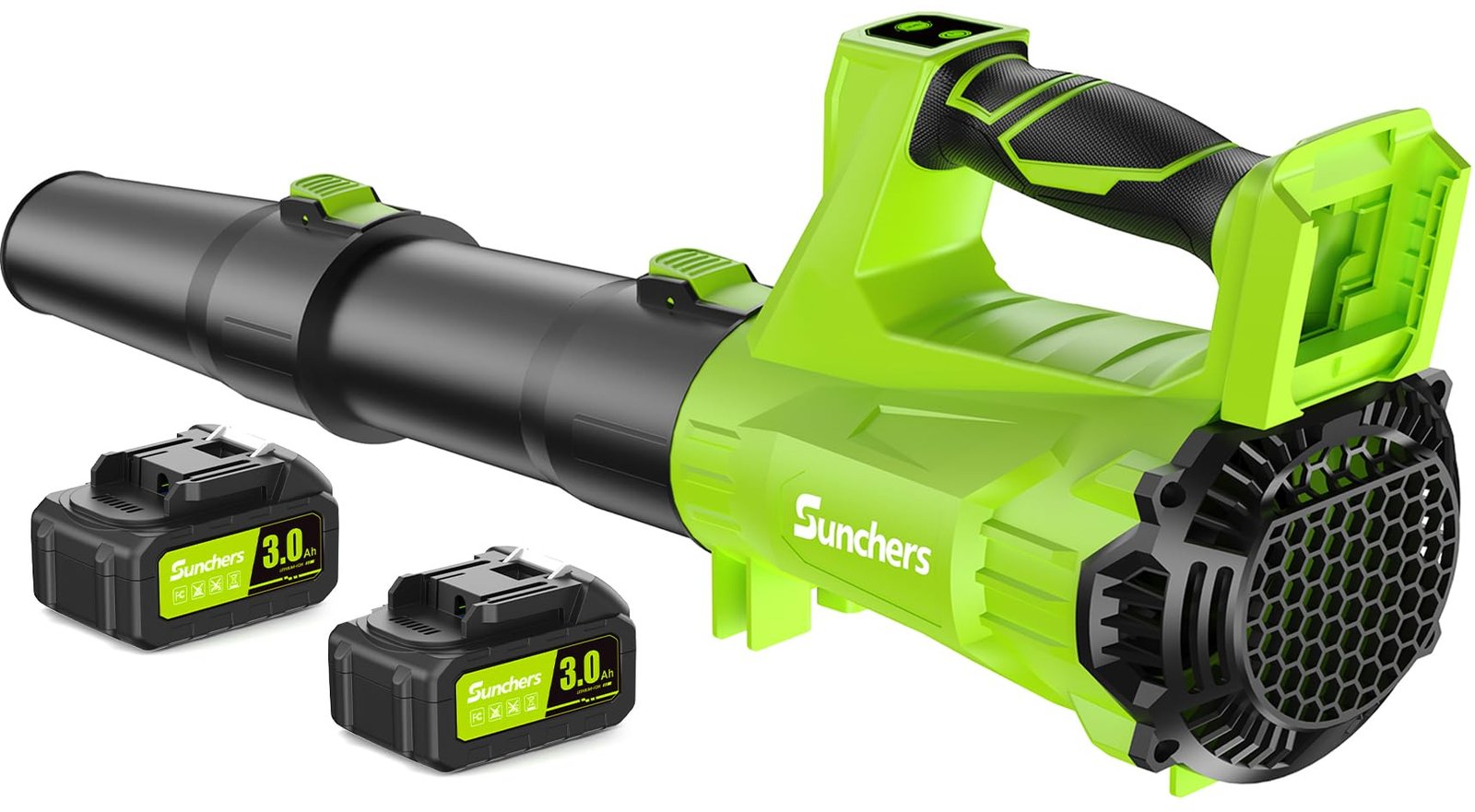
A leaf blower is mainly rated by air volume, air speed, or blowing force. In the United States, the most common ratings are CFM, MPH, and sometimes Newtons (N). Battery models also list voltage, amp-hours, and runtime. Gas models often show engine size in cubic centimeters (cc).
The most useful rating depends on your work. CFM tells you how much air the blower moves. MPH tells you how fast that air leaves the nozzle. Newtons give a better measure of total blowing force. For most homeowners, the best choice is not the blower with the highest single number. It is the model with enough airflow, useful control, acceptable noise, and adequate runtime for the job.
Introduction
In the United States, leaf blower ratings can be confusing because brands do not always measure or present them in the same way. One blower may advertise very high MPH, while another lists higher CFM. Those numbers describe different parts of performance and cannot be compared fairly without knowing the test conditions.
A good rating check starts with the work area. Small patios and driveways need less power than large lawns covered with wet leaves. Battery capacity, nozzle design, sound level, weight, and local rules also affect the real choice.
This guide explains what each leaf blower rating means, how to compare models, and which numbers matter for dry leaves, wet debris, grass clippings, and heavier yard waste.

What Do Leaf Blower Ratings Mean?
Leaf blower ratings describe the air a machine produces, but each rating measures a different feature.
| Rating | What it measures | Best use |
|---|---|---|
| CFM | Cubic feet of air moved per minute | Moving large piles of leaves |
| MPH | Air speed at or near the nozzle | Loosening wet or stuck debris |
| Newtons | Overall blowing force | Comparing total output |
| dB or dB(A) | Sound level | Estimating noise exposure |
| Volts and amp-hours | Battery system and stored energy | Comparing cordless capacity |
| CC | Gas engine displacement | Describing engine size, not direct output |
| Runtime | Operating time under stated conditions | Planning battery-powered work |
Manufacturers often publish a maximum rating. That number may occur with a narrow tube, turbo mode, or a specific nozzle. Actual airflow changes when you attach accessories, lower the power setting, or place the nozzle near the ground.
For that reason, a rating is a useful starting point, not a promise of identical field performance.
CFM: The Air Volume Rating
CFM means cubic feet per minute. It measures how much air the blower moves in one minute.
A higher CFM usually helps when you need to move:
- Large amounts of dry leaves
- Loose grass clippings
- Pine needles
- Light debris across a broad area
- Leaves over gravel or uneven ground
Think of CFM as the size of the blower’s air stream. A wide stream can move more material at once. This makes CFM especially useful for lawns, large driveways, and leaf piles.
A blower with high CFM may not have the highest MPH. That is not automatically a problem. It may still move leaves faster because it pushes a larger volume of air.
How to use CFM when shopping
Look for the CFM rating in the normal operating mode, if the manufacturer provides it. Some brands list both:
- Maximum CFM
- Operating or rated CFM
The maximum figure often comes from a special setting or test setup. The normal figure may better represent daily use.
Also check whether the stated CFM is measured:
- At the blower housing
- At the tube
- At the nozzle
- With a supplied attachment
- With or without a battery installed
Those details can change the comparison.
MPH: The Air Speed Rating
MPH means miles per hour. It describes how fast the air travels as it exits the blower.
A higher MPH can help break loose:
- Wet leaves
- Leaves stuck in grass
- Muddy or damp debris
- Small twigs
- Debris lodged in cracks
MPH is similar to the speed of water leaving a hose. A narrow nozzle can produce a faster jet, even if the total amount of water is lower. Leaf blowers work in much the same way.
A high MPH rating alone does not tell you how much material the machine can move. A blower may have very high air speed but a modest CFM. It can loosen a stubborn leaf yet take longer to clear a large yard.
Why maximum MPH can mislead
Brands may measure MPH at the end of a narrow tube. A different nozzle can reduce speed while increasing the width of the air stream. Some models also advertise a brief “boost” mode rather than the speed available during normal operation.
Use MPH to judge loosening power. Use CFM to judge how much material the blower can carry away.

CFM vs. MPH: Which Rating Matters More?
Neither rating is always better. CFM matters more for moving volume; MPH matters more for starting movement.
Use this simple guide:
| Yard task | Rating to prioritize |
|---|---|
| Clearing a small paved area | Balanced CFM and MPH |
| Moving a large leaf pile | Higher CFM |
| Removing wet leaves from grass | Higher MPH with adequate CFM |
| Clearing pine needles from cracks | Higher MPH |
| Moving grass clippings from a driveway | Moderate to high CFM |
| Working around mulch or gravel | Variable speed and controlled CFM |
| Cleaning a large lawn | High CFM and good battery or fuel capacity |
The best all-purpose blower has a balance of both. It should loosen stuck debris without creating a narrow blast that scatters leaves in every direction.
A practical comparison is to examine the relationship between the two numbers. A blower rated at 600 CFM and 150 MPH may be more useful for large-scale cleanup than one rated at 800 CFM and 100 MPH, depending on the task. However, manufacturer test methods must match before those numbers can be treated as a direct performance contest.
Newtons: A Better Blowing-Force Rating
Some manufacturers list Newtons (N) instead of, or in addition to, CFM and MPH. Newtons measure force. In blower specifications, the value represents the force produced by the moving air under a stated test method.
A Newton rating can be useful because it combines air volume and air speed into one output figure. It is often easier to compare total blowing strength by looking at Newtons than by comparing MPH alone.
However, the same caution applies: the test method matters. A manufacturer may measure force with a particular tube, nozzle, or operating mode. Do not assume that every Newton figure came from an identical independent test.
When available, use Newtons as a strong comparison point, then check CFM, MPH, controls, and runtime to see whether the blower fits your work.
How Battery Leaf Blowers Are Rated
Battery blowers add electrical ratings that describe the power system rather than direct blowing strength.
Voltage
Voltage identifies the battery platform, such as 18, 20, 40, 56, or 80 volts. A higher voltage does not automatically mean a stronger blower. Motor design, battery current, fan design, and control software also affect output.
In the United States, some tools marketed as “20V” use a nominal 18-volt battery system and advertise the maximum voltage. This naming practice makes it important to compare the complete tool specification, not voltage alone.
Amp-hours
Amp-hours, written as Ah, describe battery capacity. A higher Ah battery can often run longer, but it may also add weight and cost.
A rough energy estimate is:
[
\text{Watt-hours} = \text{Volts} \times \text{Amp-hours}
]
For example, a hypothetical 40-volt, 5-Ah battery stores about 200 watt-hours under the stated battery rating:
[
40 \times 5 = 200\text{ Wh}
]
Actual usable energy is lower or different in practice because of load, temperature, battery condition, motor efficiency, and the manufacturer’s rating method.
Runtime
Runtime is usually measured at a selected power level. A blower may run much longer on low than on turbo. Some brands provide runtime tables for different batteries and modes, while others provide only an estimate.
When comparing runtime, ask:
- Which battery was used?
- Which power setting was tested?
- Was the blower running continuously?
- Was boost mode included?
- Does the advertised runtime include pauses?
- Is the battery sold with the tool?
A bare tool may look less expensive until you add the battery and charger.

How Gas Leaf Blowers Are Rated
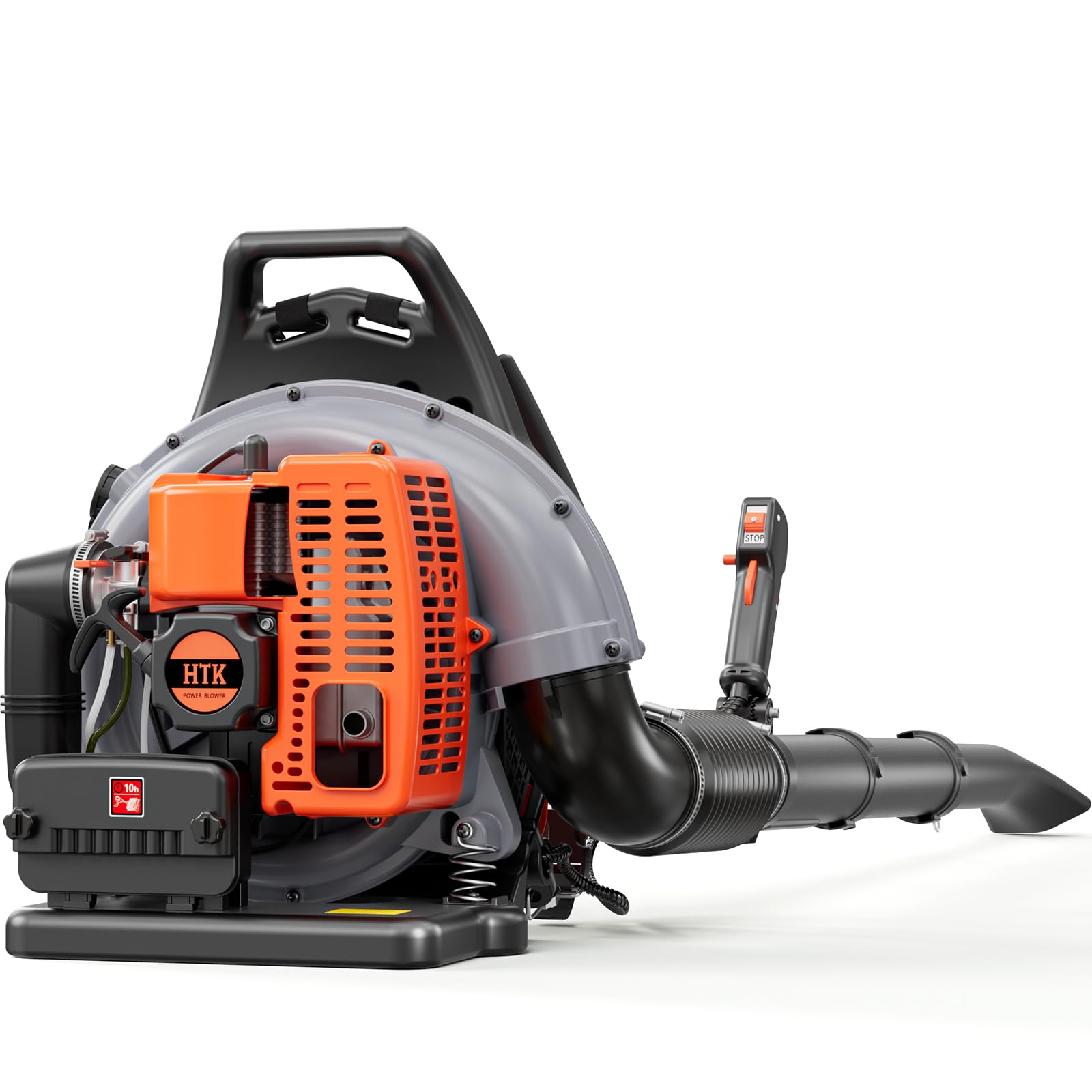
Gas leaf blowers commonly list engine displacement in cubic centimeters (cc). Engine size can suggest the class of the machine, but it is not a direct measurement of airflow or blowing force.
Two engines with similar displacement can produce different results because of differences in:
- Fan and impeller design
- Tube shape
- Engine tuning
- Exhaust and intake design
- Nozzle configuration
- Operating speed
Gas models may also list fuel tank size and estimated run time. These figures vary with throttle position and load.
The Environmental Protection Agency regulates emissions from many nonroad spark-ignition engines, and California has additional emissions rules administered by the California Air Resources Board. Compliance is separate from performance. A compliant blower is not necessarily more powerful, quieter, or more efficient than another compliant model.
Noise Ratings: dB and dB(A)
Noise is usually shown in decibels, often written as dB or dB(A). The “A” weighting adjusts the measurement to better reflect human hearing.
A higher decibel number means more sound pressure. The scale is logarithmic, so a small numerical difference can represent a meaningful change in sound level. The listed value still depends on distance, operating mode, test method, and surrounding surfaces.
Noise ratings are useful for:
- Comparing models from the same brand
- Planning work near homes or neighbors
- Checking local lawn-equipment rules
- Choosing hearing protection
- Reducing disturbance in parks or residential areas
Do not assume that a lower listed dB number guarantees quiet operation in every setting. Turbo mode may be louder than the normal setting, and hard surfaces can reflect sound.
The Occupational Safety and Health Administration provides workplace noise guidance, but residential users should also follow the blower manual and use hearing protection when sound exposure is high or prolonged. Never direct the blower toward people, animals, open windows, or traffic.
What Makes a Leaf Blower Rating Reliable?
A rating is more useful when the manufacturer clearly explains the test conditions.
Look for these details:
- Measurement location: Was the value measured at the tube, nozzle, or housing?
- Operating mode: Was it normal power, maximum power, or boost?
- Attachment: Was a flat, round, or specialized nozzle installed?
- Battery: Which battery size and charge level were used?
- Test standard: Does the company identify a method or standard?
- Units: Are all models listed in the same units?
- Real operating data: Does the manual show runtime at more than one setting?
Avoid treating a single large number as proof that one blower is superior. Manufacturer specifications are documented claims, not independent laboratory rankings.
For a fair comparison, place models in the same class and compare similar measurements. If one model lists maximum CFM at the housing and another lists CFM at the nozzle, the figures may not be equivalent.
A Practical Leaf Blower Rating Guide
The following ranges are broad buying guidelines, not universal performance standards. Actual results depend on the nozzle, debris, moisture, and yard layout.
| Intended use | Useful target |
|---|---|
| Small porch, steps, or patio | Low to moderate CFM with variable speed |
| Small driveway or walkway | Moderate CFM and moderate to high MPH |
| Large suburban yard | Higher CFM, strong battery, or sufficient fuel capacity |
| Wet leaves | Strong MPH and moderate or high CFM |
| Pine needles and stuck debris | Higher MPH and a focused nozzle |
| Large piles | High CFM and a wide or standard tube |
| Areas with mulch or gravel | Variable speed and controlled airflow |
These are decision aids, not guarantees. A skilled user can clear a small area with a low-power model, while a large machine may be frustrating around flower beds because it moves mulch and dust.
Common Mistakes When Comparing Leaf Blowers
Comparing MPH alone
This favors narrow, fast air streams and ignores total air volume. Check CFM or Newtons as well.
Comparing CFM without checking the test point
Housing CFM and nozzle CFM may not describe the same output. Read the specification notes.
Treating voltage as power
Voltage identifies part of the battery system. It does not replace airflow, force, or runtime ratings.
Ignoring the battery
A cordless blower’s advertised price may exclude the battery and charger. Include those costs in the comparison.
Choosing maximum power for every task
Full power can drain a battery quickly, create more noise, and scatter debris. Variable speed gives better control.
Using a blower on unsafe material
Do not use a leaf blower to move burning leaves, hot ash, chemicals, large stones, or sharp debris. Wear eye protection and hearing protection as directed by the manual. Keep children and bystanders away from the work area.
Assuming local rules are the same everywhere
Cities, counties, homeowners’ associations, and states may restrict gas blowers, operating hours, or noise levels. Check your local government rules before buying or using one.

How to Choose a Leaf Blower by the Numbers
Use this process:
- Measure the job. Estimate the size of the yard, driveway, patio, or work area.
- Identify the debris. Dry leaves need less force than wet leaves or pine needles.
- Set a minimum output. Choose enough CFM for volume and enough MPH or Newtons for stuck debris.
- Check control. Variable speed helps protect mulch, gravel, and garden beds.
- Check energy needs. Compare battery runtime or gas tank capacity with the time required.
- Check noise. Review the dB rating and local restrictions.
- Check weight and balance. A powerful blower is less useful if it causes fatigue.
- Read the manual. Confirm battery compatibility, attachments, maintenance, and safety limits.
The best rating profile is the one that fits your actual cleanup. For a small paved area, control and low weight may matter more than maximum output. For a large yard, CFM, force, and runtime usually matter more.
Frequently Asked Questions
Is a higher CFM or higher MPH better?
Neither is always better. Higher CFM helps move more material, while higher MPH helps loosen material that is wet or stuck. A balanced blower is usually the most useful general-purpose choice.
What is a good CFM for a home leaf blower?
The right CFM depends on the area and debris. Small patios need far less airflow than large lawns. Instead of choosing a universal number, compare the manufacturer’s CFM with the nozzle type, variable-speed control, and the size of the job.
Does a higher voltage battery make a blower stronger?
Not by itself. Voltage is one part of the electrical system. Motor design, battery current, fan design, and nozzle shape also affect CFM, MPH, and blowing force.
Are leaf blower ratings standardized?
Some measurements may follow documented industry or manufacturer methods, but specifications are not always directly comparable across brands. Check where and how the manufacturer measured CFM, MPH, Newtons, and noise.
How accurate are leaf blower runtime claims?
Runtime claims are estimates based on specific batteries, modes, and test conditions. Turbo use, wet debris, cold temperatures, battery age, and frequent speed changes can reduce actual runtime.
Conclusion: The Best Way to Read Leaf Blower Ratings
Leaf blowers are rated mainly by CFM, MPH, and Newtons. CFM measures air volume, MPH measures air speed, and Newtons describe overall blowing force. Battery voltage, amp-hours, runtime, gas engine size, and noise ratings provide important supporting information.
For a sound comparison, do not select a blower from one headline number. Match the rating to the task, confirm the test conditions, account for battery or fuel needs, and check noise and local rules. In most cases, a balanced model with variable speed will be more useful than the machine with the highest advertised MPH.
Sources and further reading
- U.S. Consumer Product Safety Commission: Outdoor power equipment safety
- Occupational Safety and Health Administration: Occupational noise exposure
- U.S. Environmental Protection Agency: Small engines and equipment
- California Air Resources Board: Small off-road engines
- American National Standards Institute
